
Treatments
Varicose Vein Treatments at LEDAS, Busan
Quick answer: LEDAS treats varicose veins with endovenous laser treatment (EVLT) using a 1940nm diode laser, combined with duplex-guided and foam sclerotherapy for hidden veins and sclerotherapy for spider and reticular veins. Everything is done under local anesthesia, without incisions, and most patients go home the same day. Your plan is set after a detailed ultrasound exam.
Key facts at a glance
- Main treatments: EVLT (laser), DGS/UGFS (ultrasound-guided and foam sclerotherapy) and SCT (sclerotherapy).
- Anesthesia: local anesthesia only – no general or spinal anesthesia, no incision.
- Hospital stay: same-day admission and discharge.
- Diagnosis: standing duplex ultrasound on Philips EPIQ Elite (4 units), about 15–20 minutes, explained in real time.
- Laser: Diotech 1940nm diode laser (2 units).
- Cost: first visit with leg ultrasound 180,000 KRW; treatment averages about 5,500,000 KRW per leg depending on stage – exact quote after ultrasound.
- Not offered: radiofrequency ablation (RFA) and VenaSeal (glue).
How does LEDAS treat varicose veins?
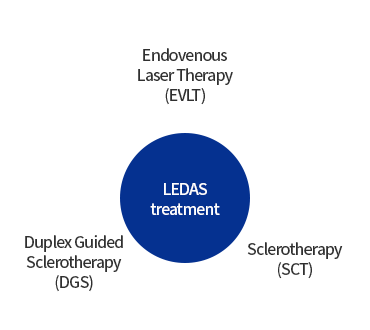
Varicose veins happen when one-way valves inside leg veins stop closing properly, so blood flows backward (reflux) and pools in the legs. Good treatment closes every vein that leaks – the large trunk veins and the small feeder veins between muscles. LEDAS combines three methods in one plan, called the LEDAS treatment system , and then follows you up over the long term.
Which tests come before treatment?
Every plan starts with ultrasound. If a leaking vein is missed, varicose veins are more likely to return, so this step matters.
- Varicose vein self-check checklist – 13 symptoms to review at home before you book.
- When to see a vein doctor – signs it is time for an exam.
- Your first visit – consultation, ultrasound and what happens next.
- Duplex ultrasound vein examination – a painless, radiation-free scan of vein structure and flow.
- Venous reflux testing – how backward flow and valve failure are measured.
- How your treatment plan is built – from ultrasound map to treatment day.
- Second opinion – bring an existing diagnosis or plan for review.
What treatments does LEDAS offer?
Laser for the main leaking veins
- EVLT – endovenous laser treatment : a thin laser fiber closes the faulty vein from inside, which the body then gradually absorbs.
- 1940nm vs 980nm/1470nm laser : why the 1940nm wavelength, strongly absorbed by water, is used.
Injection treatments
- Duplex-guided sclerotherapy (DGS) : ultrasound-guided injections into hidden veins between muscles – a key step in preventing recurrence.
- Ultrasound-guided foam sclerotherapy (UGFS) : a foamed medicine that fills and closes larger veins.
- Sclerotherapy for spider and reticular veins : fine injections into small visible veins.
- Hand vein treatment : foam sclerotherapy with carefully controlled concentration for prominent hand veins.
Special and complex cases
- KT syndrome vein management : laser or sclerotherapy when deep veins are normal, conservative care when they are not.
- Re-operation clinic : finding why veins came back and treating the cause.
- Relapse prevention program : initial treatment, intensive treatment and lifelong monitoring.
- Treating both legs : how bilateral treatment is planned.
- Why LEDAS moved away from stripping .
What is treatment day and recovery like?
- Local anesthesia, no-incision treatment
- Same-day discharge explained
- Recovery timeline – a pulling feeling for 1–2 weeks after laser is common; walking helps.
- Aftercare instructions
- Medical compression stockings and how to choose and wear them
- Side effects and risks
- Results: what to expect
- Follow-up ultrasound and long-term care – every 1–2 years, or whenever an overseas patient visits Korea.
If you develop sudden one-sided leg swelling and pain, chest pain or difficulty breathing at any time, call emergency services – these can be signs of deep vein thrombosis or pulmonary embolism.
How do the treatment options compare?
- EVLT vs radiofrequency ablation (RFA)
- EVLT vs VenaSeal (glue)
- Laser vs vein stripping surgery
- Sclerotherapy vs laser treatment
- Foam vs liquid sclerotherapy
- Surgical vs non-surgical treatment
- Compression stockings vs treatment
- Treatment in Korea vs the USA and why patients choose Korea
- Specialist vein clinic vs general hospital
How much does treatment cost?
The first visit, including consultation and leg ultrasound, is 180,000 KRW. Treatment averages about 5,500,000 KRW per leg, depending on the stage of disease. You receive an exact quote only after your ultrasound. Holders of Korean National Health Insurance should ask the international coordinator, as some costs may be covered.
LEDAS treatments compared
| Treatment | Best for | How it works | Anesthesia |
|---|---|---|---|
| EVLT (1940nm laser) | Main leaking saphenous veins | Laser fiber closes the vein from inside | Local |
| DGS (duplex-guided sclerotherapy) | Hidden veins between muscles, perforators | Ultrasound-guided injection of sclerosant | None needed |
| UGFS (foam sclerotherapy) | Larger tributaries, recurrent veins, hand veins | Foamed sclerosant under ultrasound | None needed |
| SCT (sclerotherapy) | Spider and reticular veins | Fine-needle injection into visible veins | None needed |
| Compression stockings | Support after treatment; symptom relief | Graduated pressure, tightest at the ankle | – |
Varicose vein treatments – frequently asked questions
Which treatment will I need?
It depends on what your ultrasound shows. Most patients with leaking trunk veins receive EVLT combined with ultrasound-guided sclerotherapy for smaller and hidden veins in the same plan. Spider veins alone may need only sclerotherapy. The doctor explains the plan on screen after your exam. See how your treatment plan is built.
Does LEDAS offer radiofrequency ablation or VenaSeal?
No. LEDAS uses EVLT with a 1940nm diode laser plus sclerotherapy, and does not offer RFA or VenaSeal glue. All three are recognized ways to close a refluxing vein; our comparison pages explain the differences neutrally. Read EVLT vs RFA and EVLT vs VenaSeal.
Will I need general anesthesia or stitches?
No. Laser treatment is done under local anesthesia through a needle puncture, so there is no incision and no stitches. Injection treatments usually need no anesthesia at all. You walk out the same day and are encouraged to keep walking. Read about local anesthesia, no-incision treatment.
How soon can I return to normal activity?
Most people return to daily routines the same day. A pulling feeling along the treated vein for 1–2 weeks is common, and light walking for 2–4 weeks is advised. Strenuous exercise is usually resumed gradually after your check-up. See the recovery timeline and when you can exercise.
Is treatment covered by insurance?
It depends on your insurer. Korean National Health Insurance may cover some costs, so ask the international coordinator. Overseas patients can request treatment certificates and documents in Korean or English for their own insurer. Read does insurance cover varicose vein treatment? for details.
About this page
Clinical information:
LEDAS Varicose Vein Clinic, led by
Dr. Kim Byoung Joon , thoracic and cardiovascular surgeon, founding member of the Korean Society for Phlebology.
Medical reviewer:
Dr. Kim Byoung Joon ·
Review status:
Pending ·
Last updated:
October 2026
This page is general information and not a diagnosis. Treatment is decided only after an in-person examination. Read our
editorial policy .
Related: Varicose veins guide · LEDAS treatment system · EVLT · Treatment cost · International patients
Find the right treatment for your veins
English consultation available · +82-70-4895-5086 · kbjledaspm@gmail.com
