
Treatments · Long-term care
How to Prevent Varicose Veins From Coming Back: The LEDAS Relapse Prevention Program
Quick answer: You reduce the chance of varicose veins returning by treating every leaking vein the first time, then checking regularly for new reflux. The LEDAS relapse prevention program in Busan does both: complete initial and intensive treatment guided by ultrasound, followed by lifelong follow-up scans every one to two years, or whenever overseas patients visit Korea.
Key facts at a glance
- Why it exists: varicose veins are a chronic disease with a well-known tendency to recur.
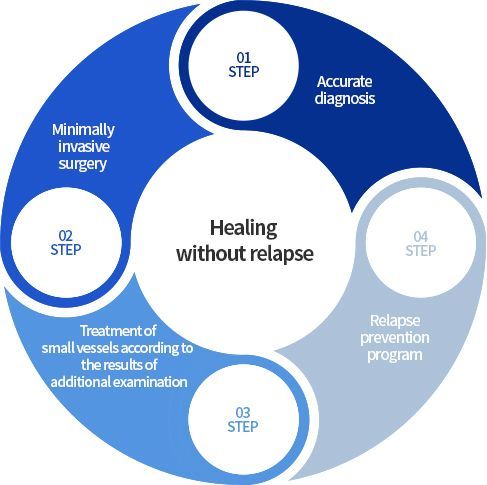
- Three stages: initial treatment (source veins) → intensive treatment (small vessels, with re-examination) → lifetime monitoring.
- Follow-up interval: ultrasound every 1–2 years, or on each visit to Korea for overseas patients.
- Continues after recovery: checks carry on even when your legs feel fine.
- At each visit: the physician scans for new reflux veins.
- If something is found: early treatment, usually ultrasound-guided sclerotherapy.
Why do varicose veins recur?
Varicose veins develop because valves inside the veins fail and blood flows backward (reflux), building pressure in the leg. Treatment closes the veins that are faulty today. It does not change the underlying tendency: weak vein walls, family history, hormones, posture at work and age all continue to act on the remaining veins. Over years, new reflux can appear in veins that were healthy before.
Recurrence also happens when the first treatment was incomplete. Dr. Kim Byoung Joon identifies three main reasons: incomplete diagnosis, the wrong treatment plan or method, and lack of preventive follow-up. The relapse prevention program is designed to address all three. For background, read can varicose veins come back?
How does the LEDAS relapse prevention program work?
Stage 1: initial treatment
The first goal is to close the veins that are causing the varicose veins, usually the main refluxing saphenous trunk. This is typically done with EVLT using a 1940nm laser, under local anesthesia with no incision.
Stage 2: intensive treatment
Next, the smaller vessels are dealt with. Hidden refluxing branches and perforators are treated with duplex-guided sclerotherapy , and visible veins with surface sclerotherapy. The leg is re-examined after treatment to confirm nothing has been missed. LEDAS considers this thoroughness one of the most important ways to prevent recurrence.
Stage 3: lifetime monitoring
After your legs have recovered, you continue to have periodic ultrasound checks. At each visit, the physician scans for new reflux. Small new problems can usually be treated quickly with an injection rather than waiting until they become large, bulging veins again. See follow-up ultrasound and long-term care for what each visit involves.
How often should I have a follow-up scan?
LEDAS recommends a follow-up examination once every one to two years. For international patients, the check can instead be done whenever you visit Korea. Follow-up continues even after full recovery, because recurrence can begin silently, without visible veins or symptoms at first.
Come sooner if you notice new bulging veins, returning heaviness, ankle swelling or skin changes.
What can I do myself to help prevent recurrence?
Treatment and monitoring do the heavy lifting, but daily habits matter too:
- Walk every day at a moderate pace. Your calf muscles act as a pump that pushes blood upward.
- Avoid long periods in one position. If you stand or sit for work, move your ankles and take short walks. See varicose veins and standing jobs .
- Raise your legs above heart level when resting.
- Limit heat exposure such as long saunas and very hot baths, which widen veins.
- Eat lightly : avoid very salty and high-calorie food and keep a healthy weight.
- Avoid smoking and limit alcohol.
- Wear compression stockings when your doctor advises, for example on long flights.
More ideas are in how to prevent varicose veins and exercises for healthy leg veins .
How does follow-up work for overseas patients?
Patients from abroad receive preventive examinations and any needed treatment each time they return to Korea. Between visits, the international coordinator stays in touch, helps you communicate with the doctor, and can arrange your next check when you plan a trip. LEDAS also has remote consultation centers in seven countries. See follow-up after you return home .
The three stages of relapse prevention
| Stage | Goal | Typical methods | Recurrence cause addressed |
|---|---|---|---|
| 1. Initial treatment | Close the source veins | Ultrasound mapping, EVLT | Incomplete diagnosis |
| 2. Intensive treatment | Treat small and hidden vessels, re-check | DGS/UGFS, sclerotherapy, re-examination | Wrong or partial treatment plan |
| 3. Lifetime monitoring | Find new reflux early | Ultrasound every 1–2 years or on each Korea visit | Lack of preventive follow-up |
Relapse prevention – frequently asked questions
Can varicose vein recurrence be completely prevented?
No treatment can promise that, because the tendency to develop new reflux remains. What you can do is lower the risk and catch problems early. Thorough first treatment plus regular ultrasound checks means new reflux is usually found while it is small and simple to treat.
Do I need follow-up if my legs feel fine?
Yes. New reflux often starts without symptoms or visible veins. That is why LEDAS continues ultrasound checks every one to two years even after full recovery. A quick scan can find changes long before they become uncomfortable or obvious.
What happens if new reflux is found at follow-up?
Usually it can be treated promptly with ultrasound-guided sclerotherapy, an injection that takes a few minutes and needs no incision. Larger problems may need laser treatment. The aim is to treat early so you avoid returning to advanced varicose veins.
Do compression stockings prevent recurrence?
They support circulation and can help, especially during long flights, pregnancy or long periods of standing. They do not repair faulty valves, though, so they work best alongside treatment and follow-up. See do compression stockings cure varicose veins?
About this page
Clinical information:
LEDAS Varicose Vein Clinic, led by
Dr. Kim Byoung Joon , thoracic and cardiovascular surgeon, founding member of the Korean Society for Phlebology.
Medical reviewer:
Dr. Kim Byoung Joon ·
Review status:
Pending ·
Last updated:
October 2026
This page is general information and not a diagnosis. Treatment is decided only after an in-person examination. Read our
editorial policy .
Related: Follow-up care · Re-operation clinic · LEDAS treatment system · Recurrent varicose veins · Prevention tips
Keep your legs healthy for the long term
English consultation available · +82-70-4895-5086 · kbjledaspm@gmail.com
