
Compare · Injection vs laser
Sclerotherapy vs Laser Treatment for Varicose Veins
Quick answer: Laser treatment (EVLT) is best for large, straight leaking veins such as the saphenous trunk, while sclerotherapy injections suit smaller, twisted, hidden or surface veins that a laser fiber cannot follow. They are not really rivals. At LEDAS in Busan, most plans combine both: laser closes the main source, then ultrasound-guided and surface sclerotherapy treat the rest.
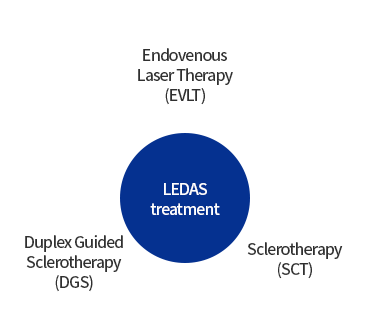
Key facts at a glance
- EVLT: heat from a laser fiber seals straight trunk veins from inside; local anesthesia.
- DGS / UGFS: ultrasound-guided injection (often foam) for hidden branches and perforators.
- SCT: surface sclerotherapy for spider and reticular veins.
- Key difference: vein size and shape decide which method fits.
- Skin lasers are different: surface (transdermal) lasers for facial or tiny leg vessels are not the same as EVLT.
- LEDAS approach: combine all three, then follow up every 1–2 years.
What is the difference between sclerotherapy and laser?
Both close unwanted veins so the body can absorb them. They differ in how they do it and which veins they suit.
- Laser (EVLT) uses heat. A fiber is passed inside the vein and laser energy seals the wall. It needs a fairly straight vein segment long enough for the fiber to travel along, and it uses local anesthesia.
- Sclerotherapy uses a medicine. A sclerosant is injected into the vein, irritating the lining so the walls stick together. It can reach veins of almost any shape, including short, twisted or hidden ones, and usually needs no anesthesia.
A note on "laser" for spider veins
When people say "laser vein treatment," they sometimes mean surface lasers aimed through the skin at tiny red vessels. That is a different technology from endovenous laser. On the legs, sclerotherapy is often preferred for spider and reticular veins. At LEDAS, "laser" refers to EVLT inside the vein.
Which veins suit laser, and which suit sclerotherapy?
Laser is usually best for
- The great or small saphenous vein with confirmed reflux.
- Other long, straight refluxing trunks large enough for a fiber.
Sclerotherapy is usually best for
- Twisted branch varicose veins (via duplex-guided sclerotherapy , often with foam).
- Leaking perforator veins.
- Recurrent veins after previous surgery.
- Reticular and spider veins (via surface sclerotherapy ).
- Patients who are older or have serious chronic illness, for whom quick injection treatment is well tolerated.
Why does LEDAS combine sclerotherapy and laser?
Treating only the main trunk can leave refluxing branches behind; treating only the branches leaves the main source leaking. Either way, symptoms and visible veins tend to return. The LEDAS system, named for Laser, Endovenous, Duplex guided, Ablation, Sclerotherapy, uses each tool where it fits best:
- Ultrasound mapping with Philips EPIQ Elite to find every refluxing segment.
- EVLT with a 1940nm laser for the main trunk.
- DGS for hidden branches and perforators. LEDAS regards this as a key step in preventing recurrence.
- SCT for visible small veins.
- Follow-up every one to two years.
How do recovery and comfort compare?
After laser, a pulling sensation along the treated vein is common for one to two weeks, and light walking is advised for two to four weeks. After sclerotherapy, you resume daily activity immediately; treated veins may feel firm and look darker for some weeks, and after foam a brief chest heaviness or dry cough can occur. See side effects and risks .
How many sessions does each need?
A laser-treated trunk is usually closed in one session. Sclerotherapy may need more than one session, depending on how many veins there are and how they respond. See how many sclerotherapy sessions do I need?
Sclerotherapy vs laser (EVLT) at a glance
| Laser (EVLT) | Sclerotherapy (DGS / SCT) | |
|---|---|---|
| How the vein closes | Heat | Sclerosing medicine |
| Best vein type | Long, straight trunks | Twisted, hidden, small or surface veins |
| Anesthesia | Local | Usually none |
| Sessions | Usually one per trunk | One or more |
| Back to daily activity | Same day; light walking 2–4 weeks | Immediately |
| Role at LEDAS | Closes the main source | Treats branches, perforators, surface veins |
Sclerotherapy vs laser – frequently asked questions
Can sclerotherapy replace laser treatment?
Sometimes, for smaller or twisted refluxing veins and some recurrences. For a large straight saphenous trunk, laser closure is usually more reliable. Many people benefit from both. The decision is made after an ultrasound shows which veins are leaking and how they are shaped.
Is laser or sclerotherapy better for spider veins?
On the legs, sclerotherapy is commonly used for spider and reticular veins. Endovenous laser cannot treat them because they are too small for a fiber. Before treating spider veins, LEDAS checks for hidden reflux that may be feeding them. See spider veins.
Which is less painful, sclerotherapy or laser?
Sclerotherapy usually involves only small needle pricks and no anesthesia. Laser needs local anesthetic injections, after which the treatment itself is usually comfortable. Both cause some temporary tenderness. See is treatment painful?
Will I need both treatments?
Many LEDAS patients do, because varicose veins usually involve both a main leaking trunk and smaller branches. Using both methods aims to treat all sources of reflux and reduce the chance of recurrence. Your plan is built after your ultrasound.
About this page
Clinical information:
LEDAS Varicose Vein Clinic, led by
Dr. Kim Byoung Joon , thoracic and cardiovascular surgeon, founding member of the Korean Society for Phlebology.
Medical reviewer:
Dr. Kim Byoung Joon ·
Review status:
Pending ·
Last updated:
October 2026
This page is general information and not a diagnosis. Treatment is decided only after an in-person examination. Read our
editorial policy .
Related: Foam vs liquid sclerotherapy · EVLT vs RFA · LEDAS treatment system · Foam sclerotherapy · Treatment planning
Find out which combination your veins need
English consultation available · +82-70-4895-5086 · kbjledaspm@gmail.com
