
Treatments · Laser
EVLT – Endovenous Laser Treatment for Varicose Veins
Quick answer: EVLT closes a leaking vein from the inside with laser energy delivered through a fiber about as thin as a hair. At LEDAS in Busan it is performed under ultrasound guidance with a 1940nm diode laser and local anesthesia only — no incision, no general or spinal anesthesia — and most patients walk out and go home the same day.
Key facts at a glance
- What it treats: the main refluxing (leaking) saphenous veins that drive varicose veins.
- Anesthesia: local anesthesia only.
- Incision: none — the fiber enters through a needle puncture.
- Laser: Diotech 1940nm diode laser (2 units at LEDAS).
- Guidance: Philips EPIQ Elite vascular ultrasound before, during and after the procedure.
- Discharge: same day; walking is encouraged immediately.
- Usually combined with: duplex-guided sclerotherapy (DGS) and sclerotherapy (SCT) as part of the LEDAS system.
What is EVLT?
Endovenous laser treatment (EVLT, also called endovenous laser ablation or EVLA) is a minimally invasive way to close a vein whose valves no longer work. When valves fail, blood flows backward down the leg (venous reflux), pressure builds in the surface veins and they swell into varicose veins. Closing the faulty vein reroutes blood into healthy deep veins, which removes the pressure that created the varicose veins.
How EVLT is performed at LEDAS
- Confirm the reflux. Dr. Kim Byoung Joon maps the leaking vein with duplex ultrasound and shows you the reverse flow on the monitor.
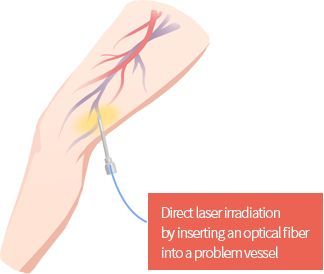
- Insert the fiber. After local anesthetic, a laser fiber as thin as a hair is guided into the vein through a needle puncture.
- Treat the vein wall. The 1940nm laser heats the inner wall of the vein as the fiber is withdrawn.
- Close the vein. The vein walls seal together and blood stops flowing through it.
- Natural absorption. Over the following weeks and months the body gradually absorbs the closed vein.
Why a 1940nm wavelength?
Laser wavelengths differ in what they heat. The 1940nm wavelength is strongly absorbed by water in the vein wall, so energy is concentrated where it is needed with less heat spreading into surrounding tissue. LEDAS uses two Diotech 1940nm diode units, described by the manufacturer as fourth-generation endovenous lasers. See 1940nm vs 980nm/1470nm laser for a fuller comparison.
Who is a good candidate?
EVLT suits most people whose ultrasound shows reflux in the great or small saphenous vein — typically those with visible bulging veins, aching or heavy legs, night cramps, swelling or skin changes. It may not be suitable during pregnancy, with an active deep vein thrombosis, or when the vein is too tortuous for a fiber; in those cases other options such as foam sclerotherapy are considered. Your plan is decided only after a full duplex ultrasound exam .
Recovery and aftercare
You walk out of the clinic the same day. A pulling sensation or tenderness along the treated vein is common for one to two weeks; regular walking and gentle ankle exercises help. Light walking is recommended for two to four weeks, along with medical compression stockings and scheduled check-ups. Read the full recovery timeline and aftercare instructions .
Risks and side effects
Like any medical procedure, EVLT carries risks, including bruising, temporary tenderness, skin pigmentation, nerve irritation and, rarely, thrombosis. Ultrasound guidance and follow-up scans are used to reduce and detect these early. Your doctor will explain individual risks before treatment — see side effects and risks .
Why EVLT is only one part of the LEDAS system
Recurrence often comes from smaller feeding veins and perforators that a laser alone does not reach. LEDAS therefore combines EVLT with duplex-guided sclerotherapy (DGS) for hidden veins, sclerotherapy (SCT) for visible small veins, and a long-term relapse prevention program with follow-up ultrasound every one to two years.
EVLT vs traditional stripping surgery
| EVLT at LEDAS | Stripping surgery | |
|---|---|---|
| Anesthesia | Local only | General or spinal |
| Incision | None (needle puncture) | Groin and leg incisions |
| Hospital stay | Same-day discharge | Often overnight or longer |
| Return to walking | Same day | Days to weeks |
| Scarring | Minimal | Visible scars possible |
EVLT – frequently asked questions
How long does EVLT take?
The laser part usually takes well under an hour per leg. With preparation, ultrasound mapping and observation afterwards, plan on spending a few hours at the clinic. See how long EVLT takes.
Is EVLT painful?
The procedure is done under local anesthesia, so most patients feel only the initial needle pricks and some pressure. A pulling sensation along the vein for one to two weeks afterward is common.
Can I walk after EVLT?
Yes. Walking is encouraged immediately after treatment and patients go home the same day.
How much does EVLT cost in Korea?
At LEDAS the first visit with consultation and leg ultrasound is 180,000 KRW. Treatment averages about 5,500,000 KRW per leg depending on disease stage. Your exact quote follows the ultrasound. See cost of treatment in Korea.
Can varicose veins come back after EVLT?
Varicose vein disease is chronic, so new refluxing veins can develop over time. LEDAS combines EVLT with sclerotherapy and long-term follow-up ultrasound to find and treat new reflux early.
About this page
Clinical information:
LEDAS Varicose Vein Clinic, led by
Dr. Kim Byoung Joon , thoracic and cardiovascular surgeon, founding member of the Korean Society for Phlebology.
Medical reviewer:
Dr. Kim Byoung Joon ·
Review status:
Pending ·
Last updated:
October 2026
This page is general information and not a diagnosis. Treatment is decided only after an in-person examination. Read our
editorial policy .
Related: LEDAS treatment system · EVLT vs RFA · 1940nm laser · Is laser treatment safe? · International patients
Find out if EVLT is right for your legs
English consultation available · +82-70-4895-5086 · kbjledaspm@gmail.com
