
FAQ · Overview
Varicose Vein FAQ: Your Questions Answered
Quick answer: Varicose veins are swollen leg veins caused by faulty valves that let blood flow backwards. They are a chronic, progressive condition that does not go away by itself. At LEDAS in Busan, a duplex ultrasound finds every leaking vein, and treatment combines EVLT laser and sclerotherapy under local anesthesia, with same-day discharge and long-term follow-up.
Key facts at a glance
- Definition: varicose veins are a chronic venous disease in which damaged valves let blood pool in the leg veins.
- Main risk factors: family history, pregnancy and hormones, long standing or sitting, ageing, excess weight.
- Diagnosis: duplex ultrasound, which shows the direction of blood flow in each vein.
- LEDAS treatments: EVLT (1940nm laser), duplex-guided sclerotherapy, sclerotherapy, compression stockings.
- Anesthesia: local only; no incision; same-day discharge.
- Costs: first visit 180,000 KRW; treatment averages about 5,500,000 KRW per leg. Exact quote after ultrasound.
This page brings together the questions patients ask us most often, grouped by topic. Each section gives a short answer and links to a full page where you can read more.
What are varicose veins and why do they happen?
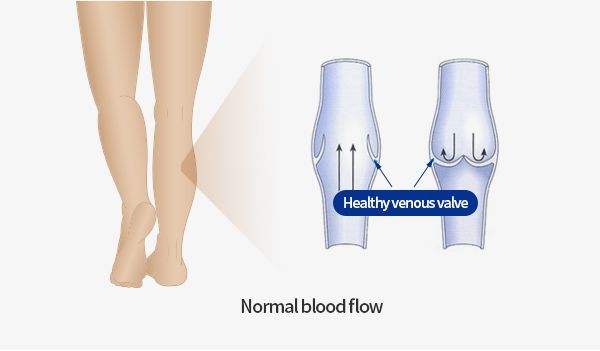
Veins carry blood back to the heart. In the legs, tiny one-way valves stop blood from falling back down, and the calf muscles act as a pump. When valves weaken or the calf pump is not used enough, blood flows backwards (reflux) and pools. Pressure rises, vein walls stretch, and veins can bulge. Some people see no bulging at all and only feel heaviness or swelling.
Common causes include family history, pregnancy and female hormones, jobs with long standing or sitting, ageing and excess weight. Read what causes varicose veins .
How do I know if I have varicose veins?
Signs you can see
- Fine red or purple spider veins (telangiectasia)
- Blue reticular veins under the skin
- Twisted, bulging veins
- Darkened skin around the ankles
Symptoms you can feel
- Aching or pulling pain, and heavy, "bursting" calves
- Swollen ankles by evening
- Night cramps
- Itchy, dry skin on the lower leg
Try the self-check checklist . Only an ultrasound can confirm the diagnosis.
How are varicose veins treated at LEDAS?
LEDAS uses a three-step system: diagnosis, treatment and relapse prevention.
- Diagnosis: a standing duplex ultrasound of about 15–20 minutes maps every leaking vein.
- Treatment: EVLT closes the main leaking vein from the inside. Duplex-guided sclerotherapy treats hidden veins, and sclerotherapy treats visible small veins.
- Relapse prevention: follow-up ultrasound every 1–2 years.
LEDAS does not use stripping surgery, radiofrequency ablation or glue.
What is recovery like?
You walk straight after treatment and go home the same day. A pulling feeling along the treated vein for 1–2 weeks is common, and treated veins may feel firm or look darker as they heal. Walk lightly every day for 2–4 weeks and wear compression stockings as advised. See the recovery timeline .
How much does treatment cost?
The first visit, including consultation and leg ultrasound, costs 180,000 KRW. Treatment averages about 5,500,000 KRW per leg, depending on the stage of disease. You get an exact quote only after the ultrasound. Details are on treatment cost in Korea .
I live abroad. Can I still be treated?
Yes. LEDAS has welcomed patients from 37 countries and has 12 remote consultation centres in 7 countries. Coordinators interpret in English, Russian and Chinese, and help with pick-up and hotels. Start at international patients .
When should I get urgent help?
Call emergency services if you have sudden chest pain, shortness of breath, coughing blood, or a leg that suddenly becomes swollen, hot and painful. These can be signs of deep vein thrombosis or pulmonary embolism.
Find the answer you need
| Your question | Short answer | Read more |
|---|---|---|
| Does it hurt? | Needle pricks and pressure under local anesthesia; mild soreness after | Is treatment painful? |
| How long does it take? | Short procedure; whole visit fits in one day | How long does EVLT take? |
| Can they come back? | Yes, new veins can form; follow-up lowers the risk | Can varicose veins come back? |
| Are they dangerous? | Not usually at first, but can progress to ulcers or clots | Are varicose veins dangerous? |
| Do stockings cure them? | No; they relieve symptoms and support recovery | Do compression stockings cure? |
| Will insurance pay? | Depends on your policy; ask the coordinator | Does insurance cover treatment? |
Varicose veins – frequently asked questions
What is the difference between spider veins and varicose veins?
Spider veins are tiny red or purple vessels in the skin, usually less than a millimetre wide. Varicose veins are larger, deeper veins that bulge because of valve failure. Spider veins can be a sign of underlying reflux, so an ultrasound is still useful. See spider veins.
Is treatment painful at LEDAS?
Most patients describe it as manageable. Local anesthesia numbs the area, so you mainly feel needle pricks and pressure. Afterwards a pulling sensation along the vein for 1–2 weeks is common. Read is varicose vein treatment painful.
Will I need general anesthesia?
No. LEDAS uses local anesthesia only, with no general or spinal anesthesia and no sedation. You stay awake, can talk with the doctor, and walk afterwards. This is one reason patients can usually go home the same day. Learn more about local anesthesia, no-incision treatment.
Can varicose veins be treated in older people?
Yes. Age alone does not rule out treatment. Injection therapy is generally well tolerated by elderly patients and those with chronic illness, and the doctor plans treatment around your overall health. See is there a best age for treatment.
What kind of doctor treats varicose veins at LEDAS?
Dr. Kim Byoung Joon, a thoracic and cardiovascular surgeon who has focused on varicose veins for over 22 years and is a founding member of the Korean Society for Phlebology. Read his profile.
How often should I have a check-up after treatment?
LEDAS recommends a follow-up ultrasound every 1–2 years, or whenever an overseas patient is next in Korea. These checks look for new leaking veins so they can be treated early. Learn about follow-up care.
About this page
Clinical information:
LEDAS Varicose Vein Clinic, led by
Dr. Kim Byoung Joon , thoracic and cardiovascular surgeon, founding member of the Korean Society for Phlebology.
Medical reviewer:
Dr. Kim Byoung Joon ·
Review status:
Pending ·
Last updated:
October 2026
This page is general information and not a diagnosis. Treatment is decided only after an in-person examination. Read our
editorial policy .
Related: Is treatment painful? · Can varicose veins come back? · Are varicose veins dangerous? · Myths & facts · Glossary
Didn't find your question? Ask our team
English consultation available · +82-70-4895-5086 · kbjledaspm@gmail.com
