
Conditions · Congenital vein disease
Klippel-Trenaunay (KT) Syndrome and Varicose Veins
Quick answer: Klippel-Trenaunay syndrome is a rare congenital vascular malformation that usually combines a wine-colored birthmark, varicose veins or malformed veins, and overgrowth of one limb. Whether the varicose veins can be treated depends on the deep veins, so the first step at LEDAS in Busan is a detailed vascular ultrasound of the whole leg.
Key facts at a glance
- What it is: a congenital (present from birth) venous malformation, also called KT syndrome or KTS.
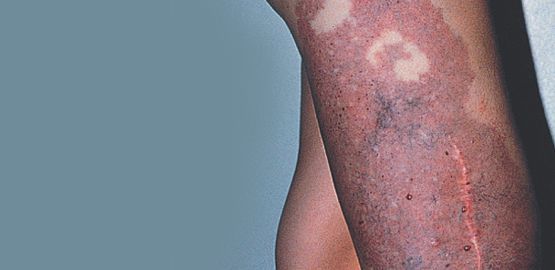
- Classic triad: a port-wine (wine-colored) birthmark, varicose veins or venous malformations, and overgrowth of the soft tissue and bone of one limb.
- Most affected area: usually one leg, though the birthmark and vessel changes can extend to the buttock or trunk.
- Key test: vascular duplex ultrasound to check whether the deep veins are present and working, and where the perforator veins are.
- Treatment rule: procedures on superficial veins are considered only when the deep veins are normal; otherwise care is conservative.
- At LEDAS: laser (EVLT) or sclerotherapy when suitable; compression stockings and medical management when not.
What is Klippel-Trenaunay syndrome?
Klippel-Trenaunay syndrome (KTS) is a rare condition in which blood vessels, soft tissue and sometimes bone develop abnormally before birth. It is a type of venous malformation : the veins did not form in the usual pattern while the baby was growing. It is not caused by anything a parent did during pregnancy, and it is not contagious.
Most people with KTS have three features, often called the classic triad:
- A capillary birthmark (nevus, often described as wine-colored or port-wine), usually on the affected leg.
- Varicose veins or venous malformations , which may be visible from early childhood. In some people the deep veins are underdeveloped (hypoplasia) or missing (aplasia).
- Overgrowth (hyperplasia) of the soft tissue and skeleton of one limb, so one leg may be longer or wider than the other.
Severe cases can also involve the bones or connective tissue. Some people have red spots or skin hemangiomas, and similar vascular changes are sometimes found in the spine or head.
How is KT syndrome different from ordinary varicose veins?
Ordinary varicose veins develop over years, usually because valves in normal veins weaken and blood flows backward (reflux). In KT syndrome the problem is structural and present from birth. Unusual veins, such as a large vein running along the outer side of the leg, may carry much of the leg's blood.
This difference matters for treatment. If the deep veins are weak or absent, the abnormal surface veins may be doing essential work. Closing them without a full map of the circulation could make swelling and congestion worse.
What symptoms does KT syndrome cause?
Symptoms vary widely, from a mild birthmark to a limb that is heavy and painful every day. Common complaints include:
- Aching, heaviness and swelling in the affected leg, often worse after standing
- Visible, bulging veins that may enlarge with age
- Differences in leg length or size, which can affect walking and posture
- Skin changes, bleeding from surface vessels, or slow-healing wounds
- Episodes of painful, tender veins caused by small clots ( superficial thrombophlebitis )
People with venous malformations can also have a higher tendency to form blood clots. Sudden swelling of the whole leg, chest pain or breathlessness needs emergency care immediately; see our page on deep vein thrombosis .
How does LEDAS diagnose KT syndrome?
At LEDAS, diagnosis starts with a detailed duplex ultrasound examination on Philips EPIQ Elite equipment. The scan answers three practical questions:
- Are the deep veins present and working? This is the single most important question.
- Where are the abnormal superficial veins, and which way does the blood flow in them?
- What size are the perforator veins and where are they? Perforators connect the surface and deep systems.
Because KT syndrome affects more than veins, some patients also need imaging such as MRI, or assessment by orthopedic, dermatology or pediatric specialists. Dr. Kim Byoung Joon will explain your ultrasound findings on screen with you and tell you honestly if another specialist should be involved.
What treatment options are available?
When the deep veins are normal
If ultrasound shows a functioning deep venous system, abnormal surface veins can often be treated. The approaches most often used are laser treatment ( EVLT ) for larger refluxing veins and ultrasound-guided foam sclerotherapy for tortuous or hidden veins. At LEDAS these are done under local anesthesia, with no incision and same-day discharge.
When the deep veins are underdeveloped
If the deep veins are absent or very small, procedures that close surface veins are usually avoided. Care is then conservative :
- Well-fitted medical compression stockings to reduce swelling and heaviness
- Anticoagulant (blood-thinning) medicine when clot risk is high
- Antibiotics if skin infection develops
- Skin care, leg elevation and regular walking
Every treatment has possible side effects, so decisions are made one patient at a time. For an overview of how LEDAS approaches KTS care, read KT syndrome vein management .
Living with KT syndrome: long-term follow-up
KT syndrome is lifelong. Veins can change with growth, pregnancy and age, so regular review matters. LEDAS recommends follow-up ultrasound every one to two years, or whenever an overseas patient visits Korea, so new problems are found early. Between visits, contact us if the leg suddenly becomes more swollen, painful, discolored or develops a wound.
KT syndrome care depends on the deep veins
| Deep veins normal | Deep veins underdeveloped or absent | |
|---|---|---|
| Role of surface veins | Abnormal and not essential for drainage | May be the leg's main drainage route |
| Procedures considered | EVLT laser and/or ultrasound-guided sclerotherapy | Usually avoided |
| Main goal | Close refluxing veins, ease symptoms | Control swelling, prevent clots and skin damage |
| Typical support | Compression stockings after treatment | Compression stockings, anticoagulants, antibiotics if needed |
| Follow-up | Ultrasound every 1–2 years | Regular review, often with other specialists |
Klippel-Trenaunay syndrome – frequently asked questions
Is Klippel-Trenaunay syndrome inherited?
KT syndrome is generally not considered an inherited condition passed from parent to child. It is linked to a genetic change that happens during early development in only some of the body's cells. That is why it usually affects one limb. A specialist or genetic counselor can discuss your family's situation in more detail.
Can KT syndrome varicose veins be removed?
Sometimes. If a duplex ultrasound shows the deep veins are normal, abnormal surface veins can often be closed with laser or sclerotherapy. If the deep veins are underdeveloped, the surface veins may be needed for drainage, so conservative care is safer. The scan decides which path fits you.
Are blood clots more common with KT syndrome?
Yes, people with venous malformations can have a higher tendency to form clots, both in surface veins and in deep veins. Your doctor may recommend compression, activity and, in some cases, anticoagulant medicine. Seek emergency care at once for sudden leg swelling, chest pain or breathlessness.
Can children with KT syndrome be seen at LEDAS?
Please contact us first. Children with KT syndrome usually need a team that includes pediatric specialists, and growth affects treatment timing. LEDAS can review ultrasound findings and explain vein-related options, and will recommend other specialists when they are better placed to lead care.
Do compression stockings help KT syndrome?
Yes. Medical compression stockings are a core part of conservative care for KT syndrome. Graduated pressure helps blood return from the leg, which reduces swelling and heaviness. They do not change the malformation itself, but many patients feel more comfortable with daily use. See choosing and wearing compression stockings.
About this page
Clinical information:
LEDAS Varicose Vein Clinic, led by
Dr. Kim Byoung Joon , thoracic and cardiovascular surgeon, founding member of the Korean Society for Phlebology.
Medical reviewer:
Dr. Kim Byoung Joon ·
Review status:
Pending ·
Last updated:
October 2026
This page is general information and not a diagnosis. Treatment is decided only after an in-person examination. Read our
editorial policy .
Related: KT syndrome vein management · What causes varicose veins? · Duplex ultrasound exam · DVT and varicose veins · Medical compression stockings
Get your KT syndrome veins mapped by ultrasound
English consultation available · +82-70-4895-5086 · kbjledaspm@gmail.com
