
Diagnosis · Planning
How Your Varicose Vein Treatment Plan Is Built
Quick answer: At LEDAS, a varicose vein treatment plan is built from a full standing duplex ultrasound map of every leaking vein. Each refluxing vein is matched to the right method: EVLT laser for main straight veins, duplex-guided sclerotherapy for hidden or tortuous veins, and sclerotherapy for small visible veins. The plan then adds re-checks and long-term follow-up to prevent relapse.
Key facts at a glance
- Foundation: standing duplex ultrasound on Philips EPIQ Elite equipment, about 15–20 minutes.
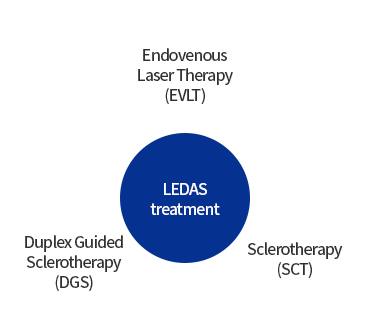
- Three treatment tools: EVLT (1940nm laser), DGS (duplex-guided sclerotherapy) and SCT (sclerotherapy).
- Three stages: initial treatment of source veins, intensive treatment of small vessels with re-examination, and lifelong recurrence prevention.
- Individualized: plans reflect your scan, health, wishes and previous treatments.
- Anesthesia: local only; no incision; same-day discharge.
- Cost: averages about 5,500,000 KRW per leg depending on stage; exact quote after ultrasound.
Why does a varicose vein plan need to be individual?
No two legs leak in the same way. One person's varicose veins come from a single faulty valve at the groin. Another's are fed by two saphenous veins, a perforator in the calf and a cluster of hidden branches. If a plan treats only what is visible, or uses one method for everything, leaking veins are left behind.
Dr. Kim Byoung Joon names three main reasons varicose veins come back: incomplete diagnosis , a wrong treatment plan or method , and lack of preventive follow-up . The LEDAS planning process is designed to address each of these.
Step 1: How is the map made?
Everything starts with a standing duplex ultrasound . Dr. Kim checks the deep veins, the great and small saphenous veins, accessory veins, perforators and surface branches, testing each for reflux . The map records:
- Where each leak starts and how far down it runs
- Vein diameters and depth below the skin
- Twisted or hidden segments that a straight laser fiber cannot follow
- Perforator veins connecting the deep and surface systems
- The health of the deep veins, which must be able to carry blood once surface veins are closed
Step 2: How is each vein matched to a method?
LEDAS uses three complementary tools. Each vein on the map is assigned the one that suits it best.
EVLT: for main straight refluxing veins
Endovenous laser treatment uses a fiber about as thin as a hair, inserted into the vein under ultrasound. A 1940nm diode laser heats the inner wall and seals the vein shut; the body gradually absorbs it. Best for long, fairly straight segments such as the great or small saphenous vein.
DGS: for hidden, tortuous or perforator veins
Duplex-guided sclerotherapy injects a sclerosing agent, often as foam, into veins that cannot be seen from the surface, such as those between muscles, under ultrasound guidance. LEDAS calls this the key step in preventing recurrence.
SCT: for small visible veins
Sclerotherapy treats reticular and spider veins at the surface with fine injections.
Step 3: How is the treatment sequenced?
The LEDAS plan unfolds in three stages:
- Initial treatment. The source veins that drive the varicose veins are closed first, usually with EVLT plus DGS on the same day.
- Intensive treatment. Remaining small vessels are treated, with an ultrasound re-examination after each session to confirm closure and catch anything left.
- Recurrence prevention. Long-term monitoring under the relapse prevention program , with follow-up ultrasound every one to two years, or each time an overseas patient visits Korea.
How many sessions you need depends on the extent of your disease. Many patients with both legs affected can have them planned together; see treating both legs .
What else shapes the plan?
- Your health: heart conditions, diabetes, past clots and medicines such as blood thinners
- Your skin: darkened or ulcerated skin often favors injection-based methods first
- Previous treatment: scarred areas after stripping usually suit foam injections
- Your travel time: international patients' schedules are considered when sequencing sessions
- Your goals: symptom relief, appearance, or both
What will I receive?
After the scan, Dr. Kim explains the plan on screen: which veins, which method, how many sessions, what recovery looks like, and the exact cost. The first visit, including consultation and ultrasound, costs 180,000 KRW; treatment averages about 5,500,000 KRW per leg depending on stage. You can take time to decide, ask questions, or seek a second opinion .
Matching each vein to a method
| Vein type on your map | Usual method at LEDAS | Why |
|---|---|---|
| Great or small saphenous vein (straight segment) | EVLT (1940nm laser) | Fiber follows the vein and seals it from inside |
| Twisted or hidden branch veins | DGS (ultrasound-guided foam) | Foam fills curved segments a fiber can't follow |
| Perforator veins | DGS | Precise injection under ultrasound |
| Reticular and spider veins | SCT (sclerotherapy) | Fine surface injections |
| Veins under damaged or ulcerated skin | DGS first, EVLT where suitable | Avoids cutting fragile skin |
| Recurrent veins after stripping | DGS and/or EVLT | Avoids re-operating on scar tissue |
Varicose vein treatment planning – frequently asked questions
How many sessions will my treatment plan include?
It depends on how many veins are leaking and where. Some patients need one main session plus a short follow-up injection; others need several sessions with a re-check after each. Your plan is explained after the ultrasound, along with an exact quote. See how many sclerotherapy sessions.
Why does LEDAS combine laser and injections?
Each method suits different veins. Laser works well in long, straight main veins, while ultrasound-guided foam reaches twisted, hidden and perforator veins that a fiber cannot follow. Combining them aims to treat every source of reflux, which LEDAS sees as essential to reducing recurrence.
Can my plan change after treatment starts?
Yes. Because each session is followed by an ultrasound re-check, the plan can be adjusted if a vein needs another injection or a new small leak appears. This step-by-step approach keeps treatment matched to what your veins are actually doing.
Can international patients finish the plan in one trip?
Often the main treatment can be completed during a short stay, because procedures use local anesthesia with same-day discharge. Remaining small-vein treatment and follow-up can be scheduled on later visits. The coordinator helps fit the plan to your travel dates.
About this page
Clinical information:
LEDAS Varicose Vein Clinic, led by
Dr. Kim Byoung Joon , thoracic and cardiovascular surgeon, founding member of the Korean Society for Phlebology.
Medical reviewer:
Dr. Kim Byoung Joon ·
Review status:
Pending ·
Last updated:
October 2026
This page is general information and not a diagnosis. Treatment is decided only after an in-person examination. Read our
editorial policy .
Related: The LEDAS treatment system · Duplex ultrasound exam · Treatment cost in Korea · Treating both legs · Second opinion
Get a treatment plan built around your own veins
English consultation available · +82-70-4895-5086 · kbjledaspm@gmail.com
