
Vein Health Guides · Reference
Vein Health Glossary: Varicose Vein Terms Explained
Quick answer: This glossary explains, in plain English, the terms you will hear at a vein clinic: reflux (backward blood flow through faulty valves), saphenous veins (the main surface leg veins), CEAP (the C0–C6 staging system), EVLT (laser closure), sclerotherapy (injection closure), duplex ultrasound and DVT. Use it to understand your scan report and treatment plan.
Key facts at a glance
- Phlebology: the medical study and treatment of veins.
- Reflux: blood flowing backward through a leaking valve – the root of most varicose veins.
- CEAP: international classification of venous disease, from C0 (no signs) to C6 (active ulcer).
- LEDAS: stands for Laser, Endovenous, Duplex guided, Ablation, Sclerotherapy.
- EVLT: endovenous laser treatment – closing a vein from inside with laser energy.
- DVT: deep vein thrombosis – a clot in a deep vein; an emergency if suspected.
Anatomy: what are the main leg veins called?
- Superficial veins: veins just under the skin, outside the muscles. Varicose veins develop here.
- Deep veins: veins inside the muscles, alongside the arteries. They carry most of the blood back from the legs.
- Great saphenous vein (GSV): the longest superficial vein, running from the inner ankle up the inner leg to the groin, where it joins the deep femoral vein.
- Small saphenous vein (SSV): a superficial vein running up the back of the calf to join the deep vein behind the knee.
- Saphenofemoral junction (SFJ): where the great saphenous vein meets the deep vein in the groin; a common site of reflux.
- Perforator veins: short veins connecting the superficial and deep systems through the muscle layer.
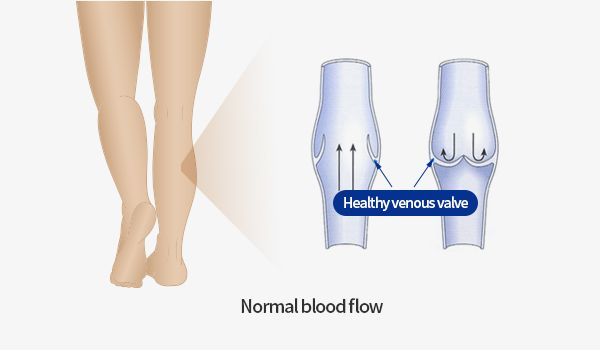
- Venous valves: one-way flaps inside veins that stop blood from falling back down.
- Calf muscle pump: the squeezing action of the calf muscles that pushes blood up the deep veins.
Conditions: what do the diagnosis terms mean?
- Varicose veins: enlarged, twisted superficial veins, usually 3 mm or wider. See varicose veins: complete guide .
- Telangiectasia (spider veins): tiny red or purple surface vessels under 1 mm. See spider veins .
- Reticular veins: flat blue-green veins 1–3 mm wide. See reticular veins .
- Venous reflux / venous insufficiency: backward flow through faulty valves.
- Chronic venous insufficiency (CVI): long-term venous disease with swelling and skin changes (CEAP C3–C6). See chronic venous insufficiency .
- Venous hypertension: raised pressure in the leg veins caused by reflux.
- Edema: swelling from fluid in the tissues, often around the ankles.
- Hyperpigmentation: brownish skin staining around the ankles from long-term venous pressure.
- Lipodermatosclerosis: hardening and tightening of the skin and fat of the lower leg.
- Venous ulcer: an open wound, usually near the inner ankle, caused by venous disease.
- Superficial thrombophlebitis: inflammation and clotting in a surface vein; tender, red cord.
- Deep vein thrombosis (DVT): a clot in a deep vein. See DVT .
- Pulmonary embolism (PE): a clot that has travelled to the lung arteries; an emergency.
- Klippel-Trenaunay (KT) syndrome: a congenital vascular condition with port-wine birthmark, abnormal veins and limb overgrowth. See KT syndrome .
- Recurrence: varicose veins returning after treatment, from new reflux or untreated veins.
Classification: what is CEAP?
CEAP stands for Clinical, Etiological, Anatomical, Pathophysiological. Doctors use the clinical part (C0–C6) to describe how advanced venous disease is. See the table below and varicose vein stages (CEAP) .
Tests: what diagnostic terms will I hear?
- Duplex ultrasound: an ultrasound that shows both the vein's structure and the direction and speed of blood flow. LEDAS uses Philips EPIQ Elite equipment. See duplex ultrasound exam .
- Color Doppler: the color display on ultrasound showing flow direction; reflux often shows as a color reversal.
- Reflux time: how long blood flows backward after a squeeze; longer than normal suggests valve failure.
- Vein mapping: marking which veins leak and where, to plan treatment.
Treatments: what do the procedure names mean?
- EVLT (endovenous laser treatment): a thin laser fiber closes the vein from inside. See EVLT .
- Endovenous thermal ablation: the general term for closing veins from inside with heat (laser or radiofrequency).
- RFA (radiofrequency ablation): heat ablation using radiofrequency energy. Not used at LEDAS.
- Cyanoacrylate closure ("glue"): sealing a vein with medical adhesive. Not used at LEDAS.
- Sclerotherapy (SCT): injecting medicine (a sclerosant) to close a vein.
- Foam sclerotherapy / UGFS: sclerosant mixed into foam and injected under ultrasound.
- DGS (duplex-guided sclerotherapy): LEDAS's term for ultrasound-guided injection into hidden veins between muscles.
- Tumescent anesthesia: dilute local anesthetic placed around the vein to numb and protect tissue.
- Stripping: the older operation of pulling a vein out through incisions.
- Ambulatory phlebectomy: removing surface veins through small skin nicks.
- Compression stockings: medical stockings with graduated pressure, tightest at the ankle.
CEAP clinical classes explained
| Class | Meaning | What you might see |
|---|---|---|
| C0 | No visible signs | Symptoms may still be present |
| C1 | Spider or reticular veins | Fine red, purple or blue veins |
| C2 | Varicose veins | Bulging, twisted veins ≥ 3 mm |
| C3 | Edema | Ankle or leg swelling |
| C4 | Skin changes | Darkening, eczema, hardening |
| C5 | Healed ulcer | Scar from a previous venous ulcer |
| C6 | Active ulcer | Open wound, usually near the ankle |
Vein terms – frequently asked questions
What does "GSV reflux" mean on my ultrasound report?
It means the valves in your great saphenous vein are leaking, so blood flows backward down the inner leg. This is one of the most common causes of varicose veins. Treatment usually closes that vein, for example with EVLT, so blood reroutes through healthy veins.
What does LEDAS stand for?
LEDAS stands for Laser, Endovenous, Duplex guided, Ablation, Sclerotherapy. It describes the clinic's approach: closing leaking veins from inside with laser, guided by duplex ultrasound, combined with sclerotherapy. See the LEDAS treatment system.
Is venous insufficiency the same as varicose veins?
They are related but not identical. Venous insufficiency describes faulty valves and backward flow; varicose veins are one visible result. Chronic venous insufficiency usually refers to more advanced disease with swelling and skin changes, CEAP C3 to C6.
What is the difference between ablation and sclerotherapy?
Ablation closes a vein from inside using energy, such as laser heat in EVLT. Sclerotherapy closes a vein by injecting a medicine that irritates its lining. Ablation suits straight main trunks; sclerotherapy suits smaller, twisted or surface veins. See sclerotherapy vs laser.
About this page
Clinical information:
LEDAS Varicose Vein Clinic, led by
Dr. Kim Byoung Joon , thoracic and cardiovascular surgeon, founding member of the Korean Society for Phlebology.
Medical reviewer:
Dr. Kim Byoung Joon ·
Review status:
Pending ·
Last updated:
October 2026
This page is general information and not a diagnosis. Treatment is decided only after an in-person examination. Read our
editorial policy .
Related: CEAP stages · Venous reflux testing · Myths & facts · Varicose vein FAQ · Treatments
Have a scan report you'd like explained?
English consultation available · +82-70-4895-5086 · kbjledaspm@gmail.com
