
Treatments · Vascular malformation
Klippel-Trenaunay (KT) Syndrome Vein Management in Korea
Quick answer: Treatment of Klippel-Trenaunay syndrome depends on whether the deep veins of the affected leg developed normally. At LEDAS in Busan, vascular ultrasound maps the deep and perforator veins first. If the deep veins are normal, laser treatment or sclerotherapy of the abnormal surface veins may be possible; if not, conservative care with compression and medication is used.
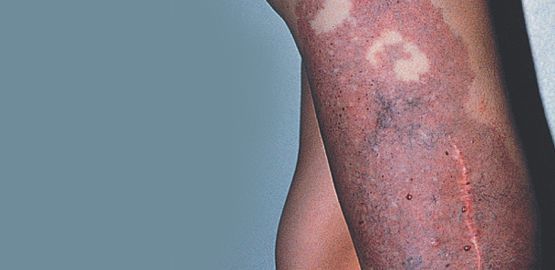
Key facts at a glance
- KT syndrome is a rare congenital vascular abnormality, a type of venous malformation present from birth.
- Classic features: a wine-colored birthmark (capillary malformation), varicose veins or venous malformations, and overgrowth of soft tissue and bone in one limb.
- Deep veins: may be underdeveloped (hypoplasia) or absent (aplasia), which shapes every treatment decision.
- Diagnosis at LEDAS: vascular ultrasound of deep vein development and of perforator size and location.
- If deep veins are normal: laser surgery or sclerotherapy is most often used.
- If deep veins are not developed: conservative care: compression stockings, anticoagulants and antibiotics as needed.
What is Klippel-Trenaunay syndrome?
Klippel-Trenaunay syndrome (KTS, or KT syndrome) is a rare condition people are born with. Blood vessels, soft tissue and sometimes bone in one limb, most often a leg, develop abnormally. It is not inherited in a simple pattern and is not caused by anything a parent did during pregnancy.
The condition is usually described by three features:
- A capillary malformation , often called a port-wine or wine-colored birthmark.
- Venous abnormalities , including varicose veins, unusual embryonic veins along the outer leg, and sometimes underdeveloped or missing deep veins.
- Overgrowth of the soft tissue and bone, so one leg may be longer or wider than the other.
Some people also have red skin spots or hemangiomas elsewhere. For a fuller description of the condition, see our Klippel-Trenaunay syndrome overview.
Why is the deep vein system so important?
Normally, most blood returns from the leg through the deep veins inside the muscles. The surface veins carry a smaller share. In KT syndrome, the deep veins can be thin, incomplete or absent. When that happens, the abnormal surface veins may be doing essential work, carrying blood the deep system cannot.
Closing those surface veins without a working deep system could make swelling and pain worse. That is why the first and most important question in KT syndrome is not "which treatment?" but "what do the deep veins look like?"
How does LEDAS assess KT syndrome?
Assessment begins with detailed duplex ultrasound on a Philips EPIQ Elite system. The doctor examines:
- Whether the deep veins are present and how well they have developed.
- The direction and speed of blood flow in deep and surface veins.
- The size and location of perforator veins connecting the two systems.
- Which abnormal veins show reflux and which may be carrying necessary flow.
Based on this map, the doctor decides whether treatment of the surface veins is possible. In complex cases, other imaging or a multidisciplinary team at a larger hospital may also be recommended.
What treatment options exist for KT syndrome veins?
When the deep veins are normal
If ultrasound confirms a functioning deep system, the abnormal superficial veins can often be treated. The approaches most often used are:
- Laser closure (EVLT) for larger, straight abnormal trunks such as a lateral embryonic vein.
- Ultrasound-guided foam sclerotherapy for tangled or irregular venous malformations and perforators.
Treatment is usually staged, with re-examination between sessions.
When the deep veins are not developed
If the deep veins are absent or very underdeveloped, closing surface veins is usually not advisable. Care focuses on comfort and preventing complications:
- Medical compression stockings to control swelling and support circulation.
- Anticoagulants where there is a raised risk of blood clots.
- Antibiotics for skin infections, to which affected limbs can be prone.
What are the risks, and when should I seek urgent care?
Every treatment can have side effects, and KT syndrome needs a specialist's judgment. People with venous malformations can have a higher risk of blood clots. Seek emergency care for sudden leg swelling with pain and warmth, sudden shortness of breath, chest pain or coughing blood. These can signal deep vein thrombosis or a pulmonary embolism .
Is KT syndrome care a lifelong process?
Yes, usually. The malformation does not disappear, and symptoms can change with growth, pregnancy or age. Regular ultrasound follow-up helps adjust care over time. LEDAS's long-term follow-up approach suits this kind of condition.
KT syndrome: how the ultrasound guides treatment
| Ultrasound finding | Treatment direction | Main goals |
|---|---|---|
| Deep veins normal, superficial reflux | Laser surgery and/or ultrasound-guided sclerotherapy | Close abnormal veins, ease symptoms |
| Deep veins underdeveloped (hypoplasia) | Mainly conservative; selective treatment only after careful review | Preserve needed outflow, control swelling |
| Deep veins absent (aplasia) | Conservative care | Compression, clot prevention, skin care |
| Large perforators or malformations | Ultrasound-guided foam sclerotherapy, staged | Reduce venous pressure and bleeding risk |
KT syndrome treatment – frequently asked questions
Can Klippel-Trenaunay syndrome be cured?
No. KT syndrome is a congenital condition, so the goal is to manage it rather than cure it. Treatment aims to reduce symptoms such as pain, heaviness and swelling, close abnormal veins when it is safe, and prevent complications like clots, infection and skin damage, with long-term follow-up.
Can varicose veins in KT syndrome be treated with laser?
Sometimes. Laser closure is considered only when ultrasound shows that the deep veins are present and working. If the deep veins are underdeveloped, the surface veins may be carrying essential blood flow, and closing them could worsen symptoms. A careful ultrasound map comes first.
Do compression stockings help KT syndrome?
Yes, they are a cornerstone of conservative care. Graduated compression helps control swelling and supports blood return from the affected limb. Because limbs may differ in size, careful fitting matters. See our compression stocking guide.
Can international patients with KT syndrome be assessed at LEDAS?
Yes. You can send existing records and images through an online consultation first. The doctor will tell you whether an in-person ultrasound in Busan is worthwhile. Final decisions are only made after a hands-on examination.
About this page
Clinical information:
LEDAS Varicose Vein Clinic, led by
Dr. Kim Byoung Joon , thoracic and cardiovascular surgeon, founding member of the Korean Society for Phlebology.
Medical reviewer:
Dr. Kim Byoung Joon ·
Review status:
Pending ·
Last updated:
October 2026
This page is general information and not a diagnosis. Treatment is decided only after an in-person examination. Read our
editorial policy .
Related: KT syndrome overview · Foam sclerotherapy · Compression stockings · DVT · Second opinion
Get your deep veins mapped before any decision
English consultation available · +82-70-4895-5086 · kbjledaspm@gmail.com
