
Compare · Treatment approaches
Non-Surgical Varicose Vein Treatment vs Surgery
Quick answer: Non-surgical varicose vein treatment closes faulty veins from the inside, using laser heat or injected medicine, instead of cutting them out. It is done through a needle under local anesthesia, so you walk out the same day. Surgery such as stripping removes veins through incisions, usually under general or spinal anesthesia. LEDAS in Busan uses EVLT and sclerotherapy.
Key facts at a glance
- "Non-surgical" here means minimally invasive procedures that close veins in place without incisions: endovenous laser (EVLT), radiofrequency ablation, adhesive closure and sclerotherapy.
- "Surgical" means open procedures that remove veins: stripping and phlebectomy.
- Conservative care (stockings, exercise, leg elevation) relieves symptoms but does not close faulty veins.
- LEDAS uses: EVLT (1940nm) + duplex-guided sclerotherapy + sclerotherapy; not RFA or glue.
- At LEDAS: local anesthesia only, no incision, same-day discharge.
- Price guide: first visit 180,000 KRW; treatment averages about 5,500,000 KRW per leg; exact quote after ultrasound.
What does "non-surgical" varicose vein treatment mean?
The term is used loosely, so it helps to be precise. In vein care, "non-surgical" usually refers to minimally invasive procedures that close a faulty vein where it lies rather than cutting it out. A needle gives access to the vein, imaging guides the work, and the body absorbs the closed vein over the following months. The main options worldwide are:
- Endovenous laser treatment (EVLT): heat from a laser fiber seals the vein.
- Radiofrequency ablation (RFA): heat from a radiofrequency catheter seals the vein.
- Cyanoacrylate adhesive (glue): medical adhesive seals the vein.
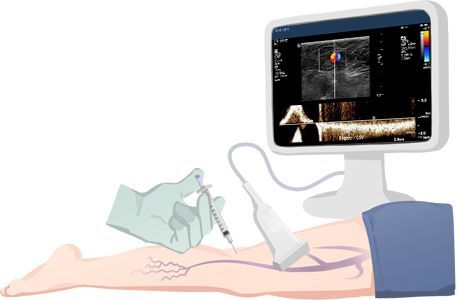
- Sclerotherapy: an injected medicine, liquid or foam, seals the vein.
LEDAS uses EVLT and sclerotherapy (both ultrasound-guided and surface). RFA and glue are explained on EVLT vs RFA and EVLT vs VenaSeal , but are not offered at LEDAS.
What does surgical treatment involve?
Traditional surgery removes veins. In stripping, the saphenous vein is tied off through a groin or knee incision and pulled out. In ambulatory phlebectomy, branch veins are hooked out through several small cuts. These operations usually need general or spinal anesthesia. LEDAS lists their drawbacks as anesthesia risk, possible nerve damage, longer recovery, incision pain and scarring, and recurrence including new veins in the surgical field and perforator reflux. See why LEDAS moved away from stripping .
How do non-surgical and surgical treatment compare?
Experience on the day
Non-surgical treatment at LEDAS uses local anesthesia without incision . You stay awake, can watch the ultrasound screen, and walk afterward. Surgery usually involves being put to sleep or numbed from the waist down, plus a recovery period before walking.
Recovery
After EVLT, light daily activity is usually possible within a day or two, a pulling sensation lasts one to two weeks, and light walking is advised for two to four weeks. After sclerotherapy, daily activity resumes immediately. Recovery after open surgery is typically longer, with incision care.
Scars and nerves
Needle access leaves tiny puncture marks; incisions leave scars. Removing veins by pulling carries a higher risk of injuring nearby skin nerves.
Suitability
Injection treatment is well tolerated by older patients and people with serious chronic illness, since it avoids general anesthesia. Where skin damage or ulcers have developed, non-surgical treatment such as ultrasound-guided sclerotherapy is generally recommended first, because surgery in damaged skin is harder.
Is non-surgical treatment just as effective?
Minimally invasive thermal ablation and ultrasound-guided sclerotherapy are widely used, established treatments for suitable veins. The bigger determinant of success is whether the diagnosis is complete and every refluxing vein is treated, including hidden branches and perforators, followed by long-term monitoring. That is the logic of the LEDAS approach: map with ultrasound, close the trunk with laser, treat hidden and visible branches with sclerotherapy, then follow up every one to two years. See the LEDAS treatment system .
What about stockings and lifestyle changes alone?
Medical compression stockings , walking, leg elevation and avoiding heat can ease symptoms and may slow progression. They do not close faulty veins, so they are considered supportive rather than main treatment. They are especially useful during pregnancy or when treatment must wait. See compression stockings vs treatment .
Three approaches to varicose veins compared
| Non-surgical (LEDAS: EVLT + sclerotherapy) | Surgical (stripping, phlebectomy) | Conservative (stockings, lifestyle) | |
|---|---|---|---|
| Closes faulty veins? | Yes, in place | Yes, by removal | No |
| Anesthesia | Local only | General or spinal | None |
| Incisions | None | Yes | None |
| Going home | Same day | Varies | Not applicable |
| Main role | Definitive treatment of reflux | Definitive treatment of reflux | Symptom relief, support |
| Follow-up needed? | Yes, every 1–2 years | Yes | Yes, to monitor progression |
Surgical vs non-surgical treatment – frequently asked questions
Can varicose veins be treated without surgery?
In most cases, yes. Minimally invasive treatments such as endovenous laser and ultrasound-guided sclerotherapy close faulty veins without incisions. At LEDAS they are done under local anesthesia with same-day discharge. Suitability is confirmed by an ultrasound examination.
Who still needs open surgery for varicose veins?
Open surgery is used less often than before, but some hospitals still perform it in particular situations or where endovenous equipment is not available. At LEDAS, varicose veins are treated with laser and sclerotherapy. Your doctor will explain after your scan whether your veins are suitable.
Is non-surgical treatment safe for older adults?
Generally it is well tolerated, because it avoids general and spinal anesthesia and lets you walk straight away. Your doctor still reviews your health and medications first. See varicose veins in older adults.
Is non-surgical treatment covered by health insurance?
That depends on your insurer and country. For Korean National Health Insurance policyholders, some costs may be covered; check with the LEDAS international coordinator. International patients can request medical documents in Korean or English for claims. See insurance documents.
About this page
Clinical information:
LEDAS Varicose Vein Clinic, led by
Dr. Kim Byoung Joon , thoracic and cardiovascular surgeon, founding member of the Korean Society for Phlebology.
Medical reviewer:
Dr. Kim Byoung Joon ·
Review status:
Pending ·
Last updated:
October 2026
This page is general information and not a diagnosis. Treatment is decided only after an in-person examination. Read our
editorial policy .
Related: Laser vs stripping · Local anesthesia, no incision · Stockings vs treatment · EVLT vs RFA · Sclerotherapy vs laser
Find out if you can avoid surgery
English consultation available · +82-70-4895-5086 · kbjledaspm@gmail.com
