
Treatments · Our approach
Vein Stripping Surgery: Why LEDAS Moved to Modern Treatment
Quick answer: Vein stripping surgery removes the main saphenous vein by tying it off through a groin or knee incision and pulling it out, usually under general or spinal anesthesia. LEDAS in Busan no longer relies on stripping. Instead, it closes faulty veins from the inside with a 1940nm laser and ultrasound-guided sclerotherapy, using local anesthesia only and no incision.
Key facts at a glance
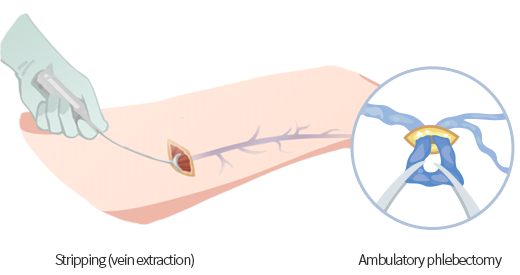
- Stripping: surgical removal of the great or small saphenous vein through incisions.
- Ambulatory phlebectomy: removal of branch veins through several small skin cuts.
- Typical anesthesia for stripping: general or spinal.
- Drawbacks noted by LEDAS: nerve damage risk, longer recovery, incision pain and scarring, recurrence including new veins in the surgical field and perforator reflux.
- LEDAS alternative: EVLT + DGS + SCT, under local anesthesia, no incision, same-day discharge.
- Experience: Dr. Kim Byoung Joon, thoracic and cardiovascular surgeon, over 22 years of varicose vein practice.
What is vein stripping surgery?
For much of the 20th century, stripping was the standard operation for varicose veins. The surgeon makes an incision in the groin (for the great saphenous vein) or behind the knee (for the small saphenous vein), ties off the vein where it joins the deep system, passes a long instrument called a stripper down the vein, and pulls the vein out through a second cut lower on the leg. Branch varicose veins are often removed at the same time through several small cuts, a technique called ambulatory phlebectomy.
Because the operation involves incisions and the physical removal of a long vein, it is usually done under general or spinal anesthesia.
Why did LEDAS move away from stripping?
Dr. Kim Byoung Joon trained as a thoracic and cardiovascular surgeon and has focused on varicose veins for over 22 years. Over that time, LEDAS built its approach around minimally invasive methods because of the drawbacks of traditional surgery:
- Anesthesia: general or spinal anesthesia carries its own risks and recovery time.
- Nerve injury: sensory nerves lie close to the saphenous veins, especially below the knee, and can be damaged when the vein is pulled out.
- Recovery: incisions and tissue trauma mean more pain, bruising and time off.
- Scarring: groin and leg incisions leave scars.
- Recurrence: new vessels can grow in the surgical field (neovascularization), and reflux can develop in perforator veins.
What does LEDAS do instead?
LEDAS stands for Laser, Endovenous, Duplex guided, Ablation, Sclerotherapy. Instead of removing veins, the LEDAS system closes them from the inside and lets the body absorb them:
- EVLT closes the main saphenous trunk with a 1940nm diode laser fiber inserted through a needle puncture.
- DGS treats hidden refluxing branches and perforators with ultrasound-guided injections.
- SCT fades visible spider and reticular veins.
All three use local anesthesia without incision , and patients go home the same day. The aim is to minimize pain, bleeding, scarring and nerve damage while treating every source of reflux.
Is stripping ever still used?
Stripping remains a recognized operation and is still performed in some hospitals and situations. Endovenous techniques such as laser and radiofrequency ablation have, however, become widely used first-line options for suitable veins in many countries. At LEDAS, varicose veins are treated with EVLT and sclerotherapy rather than stripping. For a detailed side-by-side, see laser vs vein stripping surgery .
I already had stripping. What now?
Many people who come to LEDAS had stripping years earlier and have noticed veins returning. Recurrence after stripping often comes from new vessels near the old surgical site, residual vein segments, or perforator veins. Because repeat open surgery through scar tissue is difficult, these are usually best treated with ultrasound-guided foam sclerotherapy and, where a straight vein remains, laser. The re-operation clinic is designed for exactly this situation; see also recurrent varicose veins .
Stripping surgery vs the LEDAS system
| Stripping + phlebectomy | LEDAS system (EVLT + DGS + SCT) | |
|---|---|---|
| What happens to the vein | Physically pulled out | Closed in place, then absorbed |
| Anesthesia | General or spinal | Local only |
| Incisions | Groin/knee plus small leg cuts | None (needle puncture) |
| Nerve injury risk | Higher, especially below the knee | Minimized with ultrasound guidance |
| Hidden branches and perforators | Not always addressed | Targeted with ultrasound-guided injections |
| Going home | Varies; sometimes a hospital stay | Same day |
Vein stripping – frequently asked questions
Is vein stripping still necessary today?
For many people it is no longer the first choice, because endovenous laser and other minimally invasive methods can close the same veins without incisions. Whether any particular method suits you depends on your ultrasound findings. LEDAS treats varicose veins with laser and sclerotherapy rather than stripping.
Why does leaving the closed vein in the leg not cause problems?
After laser or sclerotherapy, the closed vein no longer carries blood. Over the following months the body gradually breaks it down and absorbs it, much like it clears a bruise. Blood simply flows through the healthy deep veins instead.
Do my old stripping scars affect new treatment?
They can make repeat open surgery difficult, which is one reason minimally invasive treatment is preferred for recurrences. Ultrasound-guided injections and laser work from inside the vein and do not need to pass through scar tissue in the same way.
Is laser treatment as thorough as stripping?
Laser closes the main trunk from inside rather than removing it. Thoroughness comes from accurate ultrasound diagnosis and treating every refluxing vein, including hidden branches and perforators. That combined approach is the core of the LEDAS system. See laser vs stripping.
About this page
Clinical information:
LEDAS Varicose Vein Clinic, led by
Dr. Kim Byoung Joon , thoracic and cardiovascular surgeon, founding member of the Korean Society for Phlebology.
Medical reviewer:
Dr. Kim Byoung Joon ·
Review status:
Pending ·
Last updated:
October 2026
This page is general information and not a diagnosis. Treatment is decided only after an in-person examination. Read our
editorial policy .
Related: Laser vs stripping · Surgical vs non-surgical · LEDAS treatment system · Re-operation clinic · LEDAS history
Explore treatment without stripping or incisions
English consultation available · +82-70-4895-5086 · kbjledaspm@gmail.com
