
Treatments · Injection therapy
Ultrasound-Guided Foam Sclerotherapy (UGFS)
Quick answer: Foam sclerotherapy treats varicose veins by mixing a sclerosing medicine with air into a fine foam and injecting it into the vein. The foam pushes blood aside and stays in contact with the vein wall, which then seals and is gradually absorbed. At LEDAS in Busan it is done under ultrasound, with no incision or anesthesia, and you walk out immediately.
Key facts at a glance
- What it is: a sclerosant medicine whipped with air (or gas) into a microfoam and injected into a vein.
- Why foam: it displaces blood instead of mixing with it, so a smaller dose can treat a larger vein.
- Guidance: foam shows up brightly on ultrasound, so the doctor can watch where it goes.
- Best for: medium-sized varicose branches, perforator veins, recurrent veins and veins too twisted for a laser fiber.
- At LEDAS: part of the combined system with EVLT and surface sclerotherapy; also used, in carefully adjusted strength, for hand veins.
- Recovery: walk immediately; light walking for 2–4 weeks; regular check-ups.
What is foam sclerotherapy?
Sclerotherapy has been used for decades to close unwanted veins with an injection. Traditionally the medicine was injected as a liquid. In foam sclerotherapy, the same type of medicine is mixed with air, usually by passing it rapidly between two syringes, to create a fine, stable foam.
Liquid quickly mixes with blood and becomes diluted. Foam behaves differently: it pushes the blood out of the way and fills the vein like a plug, so the medicine touches the whole inner wall at full strength. That makes foam well suited to larger veins than liquid can effectively treat. For a detailed side-by-side, see foam vs liquid sclerotherapy .
Why is ultrasound guidance important?
Foam is highly visible on duplex ultrasound. When it is injected under imaging, the doctor can:
- Confirm the needle tip is inside the right vein.
- Watch the foam travel along the vein and stop it where needed.
- Keep the foam away from the deep veins by positioning the leg and applying pressure with the probe.
- Use the smallest effective amount.
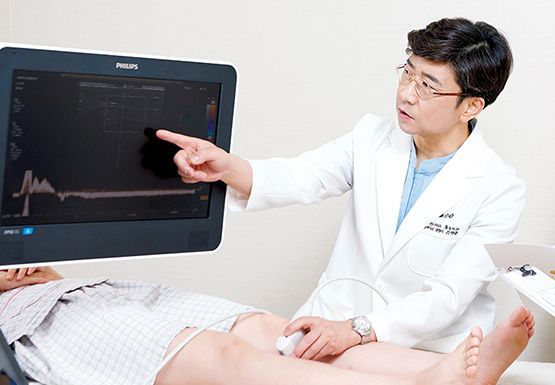
At LEDAS, this is done with Philips EPIQ Elite ultrasound systems. The technique is called UGFS (ultrasound-guided foam sclerotherapy) and overlaps closely with what the clinic calls duplex-guided sclerotherapy (DGS) .
Which veins can foam sclerotherapy treat?
Good candidates
- Twisted varicose branches that a laser fiber cannot pass through.
- Leaking perforator veins.
- Veins that remain after laser closure of the main trunk.
- Recurrent varicose veins after previous stripping or ablation, including tangled networks of new veins.
- Prominent veins on the back of the hand, using a carefully reduced concentration (see hand vein treatment ).
When another method may suit better
A large, straight saphenous trunk with significant reflux is usually closed more reliably with EVLT . Very fine spider veins are often treated with low-strength liquid. Your plan is decided after the ultrasound scan.
What happens during a foam sclerotherapy session?
- Your doctor reviews the vein map from your scan and marks the targets.
- You lie on the treatment table; the skin is cleaned.
- The foam is prepared fresh, just before injection.
- A fine needle is placed into the vein under ultrasound and the foam is injected slowly while the doctor watches.
- Your leg may be kept still briefly, then a compression stocking is applied.
- You walk around before leaving, to keep blood flowing well in the deep veins.
The injection itself takes only a few minutes. No incision and no anesthesia are needed.
What are the side effects of foam sclerotherapy?
Most effects are temporary and part of healing: the treated vein feels firm, looks darker or bruised, and is mildly tender for a few weeks. Some people notice brief chest tightness, a dry cough or a visual flicker right after a foam injection; these usually pass quickly. Brown skin staining along the vein can take months to fade. Rarely, clots can form in deeper veins. Read more on side effects and risks .
Call emergency services if you develop sudden breathlessness, chest pain, coughing blood, or weakness or numbness on one side of the body.
Foam sclerotherapy compared with EVLT
| Foam sclerotherapy (UGFS) | EVLT laser | |
|---|---|---|
| How the vein closes | Chemical irritation of the wall | Heat from inside the vein |
| Best for | Twisted branches, perforators, recurrences | Straight saphenous trunks |
| Anesthesia | None needed | Local anesthesia |
| Session time | A few minutes of injection | Longer; includes fiber placement |
| Sessions | Sometimes more than one | Usually one per vein |
| Back to daily activity | Immediately | Same day |
Foam sclerotherapy – frequently asked questions
Does foam sclerotherapy work on large varicose veins?
It can work on medium and some larger veins because foam displaces blood rather than becoming diluted. For a large, straight saphenous trunk, laser closure is often more reliable, so LEDAS frequently combines EVLT for the trunk with foam for the branches.
Is foam sclerotherapy painful?
Most people feel only a small pinprick from the fine needle and perhaps a brief cramp or warmth. No anesthesia is needed. Afterward the treated vein may feel tender or firm for a few weeks, which usually settles with walking. See is treatment painful?
How soon can I go back to work after foam sclerotherapy?
Usually the same day. You can walk immediately and resume ordinary daily activity. Avoid heavy exercise, saunas and hot baths for a short period as your doctor advises, and keep wearing your compression stocking. See when can I exercise?
Why are my veins darker after foam treatment?
Darkening is common and usually means trapped blood and pigment inside the closed vein. It is part of normal healing and fades gradually, sometimes over several months. If a firm lump is very tender, the clinic may release the trapped blood with a tiny needle.
Can foam sclerotherapy treat recurrent varicose veins?
Yes, it is one of the most useful tools for recurrence. New veins after earlier surgery are often tangled and irregular, which suits foam better than a laser fiber. LEDAS treats recurrences through its re-operation clinic.
About this page
Clinical information:
LEDAS Varicose Vein Clinic, led by
Dr. Kim Byoung Joon , thoracic and cardiovascular surgeon, founding member of the Korean Society for Phlebology.
Medical reviewer:
Dr. Kim Byoung Joon ·
Review status:
Pending ·
Last updated:
October 2026
This page is general information and not a diagnosis. Treatment is decided only after an in-person examination. Read our
editorial policy .
Related: Duplex-guided sclerotherapy · Foam vs liquid · Sclerotherapy · How many sessions? · Aftercare
Ask whether foam sclerotherapy fits your veins
English consultation available · +82-70-4895-5086 · kbjledaspm@gmail.com
