
Treatments · The LEDAS system
The LEDAS Varicose Vein Treatment System
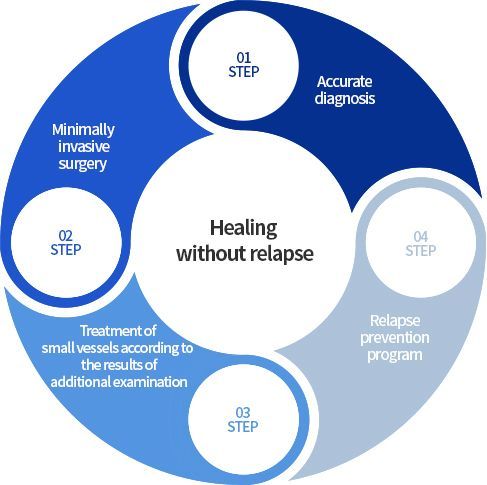
Quick answer: The LEDAS system, developed by Dr. Kim Byoung Joon in Busan, combines three steps: precise duplex ultrasound diagnosis, minimally invasive treatment with EVLT laser plus duplex-guided and standard sclerotherapy, and lifelong relapse prevention. LEDAS stands for Laser, Endovenous, Duplex guided, Ablation, Sclerotherapy. Treatment uses local anesthesia only, with no incision and same-day discharge.
Key facts at a glance
- LEDAS = Laser, Endovenous, Duplex guided, Ablation, Sclerotherapy.
- Three steps: 1) Diagnosis, 2) Treatment, 3) Relapse prevention.
- Equipment: 4 Philips EPIQ Elite ultrasound units; 2 Diotech 1940nm diode lasers.
- Treatments: EVLT + DGS (duplex-guided sclerotherapy) + SCT (sclerotherapy).
- Patient experience: local anesthesia only, no incision, same-day admission and discharge.
- Experience: varicose vein practice since 2001 (over 22 years); more than 20,000 varicose vein procedures.
- Accreditation: JCI-accredited for 4 consecutive cycles (2015–2028).
What is the LEDAS treatment system?
The LEDAS treatment and relapse-prevention system is the approach developed by Dr. Kim Byoung Joon , a thoracic and cardiovascular surgeon who has focused on varicose veins since 2001. It grew from his clinical experience and from a simple observation: varicose veins often return when diagnosis is incomplete, the treatment does not match the problem, or follow-up stops.
The name describes its building blocks: L aser, E ndovenous, D uplex guided, A blation, S clerotherapy. Rather than relying on a single technique, the system combines laser endovenous treatment, ultrasound-guided sclerotherapy and standard sclerotherapy, held together by ultrasound at every stage.
Step 1: How does LEDAS diagnose varicose veins?
LEDAS believes treatment success depends on diagnostic accuracy, which in turn depends on experience and equipment. Every patient has a standing duplex ultrasound on one of four Philips EPIQ Elite units. The scan shows vessel size, shape and flow direction, and tests valve function to map reflux . It takes about 15–20 minutes, and before it starts you are shown how to read the monitor, so you can follow your own exam as Dr. Kim interprets it in real time.
Ultrasound is not used once and put away. It guides the procedure itself and is used afterward to confirm results and watch for new reflux. Learn more about the EPIQ Elite ultrasound .
Step 2: How does LEDAS treat varicose veins?
Treatment combines three methods, chosen vein by vein from the ultrasound map:
- EVLT (endovenous laser treatment). A fiber about as thin as a hair is passed into the leaking vein. The 1940nm diode laser heats the inner wall so it seals shut, and the closed vein is gradually absorbed. The 1940nm wavelength is strongly absorbed by water, which helps limit effects on surrounding tissue.
- DGS (duplex-guided sclerotherapy). Under ultrasound, a sclerosing agent is injected into dilated veins hidden between the muscles that cannot be seen from the skin. LEDAS regards DGS as the key step in preventing recurrence, and it requires highly trained staff.
- SCT (sclerotherapy). Fine injections close visible reticular and spider veins.
All three are performed under local anesthesia only, with no general or spinal anesthesia and no incision. Injection treatments take a few minutes, and LEDAS notes they are well tolerated by elderly patients and people with serious chronic illnesses. You walk after treatment and go home the same day.
How is this different from stripping?
Traditional stripping and ambulatory phlebectomy remove veins through incisions, usually under general or spinal anesthesia. LEDAS lists their drawbacks as nerve damage risk, incision pain and scarring, a longer recovery, and recurrence from new vessels in the surgical field or perforator reflux. The LEDAS system was designed to avoid these. See why LEDAS moved away from stripping .
Step 3: How does LEDAS prevent relapse?
Varicose vein disease is chronic, so LEDAS treats it as a long-term relationship. The relapse prevention program has three stages:
- Initial treatment: closing the veins that caused the varicose veins
- Intensive treatment: treating small vessels, with re-examination after each session
- Lifetime management: follow-up ultrasound every one to two years, or whenever an overseas patient visits Korea, continuing even after full recovery
At each visit, the doctor scans for new reflux so it can be treated early, usually with a quick injection. For patients whose veins have already recurred, LEDAS also runs a dedicated re-operation clinic .
What does treatment day look like?
A typical day includes admission, an ECG, a pre-procedure ultrasound, EVLT and injection therapy, compression stocking training, monitored walking exercises, and discharge. Aftercare includes light walking for two to four weeks; some pulling discomfort for one to two weeks after laser is common. See the 10-step treatment process for international patients.
How much does it cost?
The first visit (consultation and leg ultrasound) costs 180,000 KRW. Treatment averages about 5,500,000 KRW per leg depending on disease stage, with an exact quote after the ultrasound.
The three steps of the LEDAS system
| Step 1: Diagnosis | Step 2: Treatment | Step 3: Relapse prevention | |
|---|---|---|---|
| Goal | Map every refluxing vein | Close each leaking vein with the best-suited method | Find and treat new reflux early |
| Tools | Philips EPIQ Elite duplex ultrasound | EVLT (1940nm laser), DGS, SCT | Follow-up ultrasound, injections as needed |
| Time | About 15–20 minutes | Same-day admission and discharge | Every 1–2 years, lifelong |
| Anesthesia | None needed | Local only | Local only, if treatment needed |
| Addresses | Incomplete diagnosis | Wrong plan or method | Lack of follow-up |
The LEDAS treatment system – frequently asked questions
What does LEDAS stand for?
LEDAS stands for Laser, Endovenous, Duplex guided, Ablation, Sclerotherapy. The name reflects the system's combination of endovenous laser treatment, ultrasound-guided (duplex-guided) sclerotherapy and standard sclerotherapy. It is also the name of the clinic, Kim Byoung Joon LEDAS Varicose Vein Clinic, used since 2015.
Does LEDAS offer radiofrequency ablation or VenaSeal glue?
No. LEDAS uses EVLT with a 1940nm diode laser together with duplex-guided sclerotherapy and sclerotherapy. Radiofrequency ablation and cyanoacrylate glue are other recognized methods offered elsewhere. You can compare them on EVLT vs RFA and EVLT vs VenaSeal.
Is the LEDAS system suitable for everyone?
Most people with varicose veins can be treated with it, but suitability is decided after the ultrasound and a health review. Some conditions, such as deep vein problems, pregnancy or certain malformations, need a modified plan or conservative care first. Dr. Kim will explain what fits you.
How does lifelong follow-up work if I live abroad?
Overseas patients have preventive ultrasound checks, and any needed treatment, each time they visit Korea. Between visits, the international coordinator keeps in touch and helps you communicate with the doctor. See follow-up after you return home.
About this page
Clinical information:
LEDAS Varicose Vein Clinic, led by
Dr. Kim Byoung Joon , thoracic and cardiovascular surgeon, founding member of the Korean Society for Phlebology.
Medical reviewer:
Dr. Kim Byoung Joon ·
Review status:
Pending ·
Last updated:
October 2026
This page is general information and not a diagnosis. Treatment is decided only after an in-person examination. Read our
editorial policy .
Related: EVLT laser treatment · Duplex-guided sclerotherapy · Relapse prevention program · How your treatment plan is built · All treatments
Diagnose, treat, prevent: start with the LEDAS system
English consultation available · +82-70-4895-5086 · kbjledaspm@gmail.com
