
Varicose Vein FAQ · Recovery
Will Varicose Vein Treatment Leave Scars?
Quick answer: Modern needle-based treatments such as EVLT and sclerotherapy do not leave surgical incision scars, because the vein is reached through a needle puncture rather than a cut. You may see bruising, small puncture marks or temporary darkening along treated veins, which usually fade over weeks to months. At LEDAS, all treatment is done without incisions under local anesthesia.
Key facts at a glance
- Entry point: EVLT uses a needle puncture to pass a hair-thin laser fiber into the vein; no incision is made.
- Sclerotherapy: fine-needle injections only.
- Stripping surgery: the older method uses groin and leg incisions, which leave scars.
- Common temporary marks: bruising, tiny puncture spots, firm or darkened treated veins.
- Hyperpigmentation: brownish staining along an injected vein can occur and usually fades gradually.
- Anesthesia at LEDAS: local only, with same-day discharge.
Why do people worry about scars?
For decades the standard operation for varicose veins was vein stripping . A surgeon made an incision in the groin and further cuts down the leg, then pulled the vein out. Many people still picture this operation, along with the scars it left. Modern treatment works very differently.
Does EVLT leave a scar?
Endovenous laser treatment (EVLT) closes the leaking vein from the inside. Under ultrasound, the doctor places a needle into the vein, passes a laser fiber about as thin as a hair through it, and seals the vein with laser energy. The vein is left in place and slowly absorbed by the body.
Because there is no incision, there is no stitched wound to heal and no surgical scar. What you may see instead:
- A tiny puncture mark where the needle entered, similar to a blood test.
- Bruising along the treated vein, which fades over a couple of weeks.
- A pulling or tight feeling along the vein for 1–2 weeks as it seals.
At LEDAS, EVLT uses a 1940nm diode laser. This wavelength is strongly absorbed by water in the vein wall, which helps limit heat spread to surrounding tissue. Learn more about the 1940nm laser .
Does sclerotherapy leave marks?
Sclerotherapy uses a very fine needle to inject medicine into the vein. It does not cut the skin. However, a few temporary changes are common:
Darkening and firmness
Treated veins may look darker and feel hard for a while. This is the closed vein being broken down and absorbed, and it is part of normal healing.
Hyperpigmentation
Some people develop a brownish line or spots along a treated vein. This comes from iron in old blood staining the skin. It usually lightens gradually over months. It is more noticeable in some skin types and when larger surface veins are treated.
Matting
Occasionally, a fine blush of new tiny vessels appears near a treated area. This often settles over time and can be treated if it persists.
What about phlebectomy?
Ambulatory phlebectomy removes bulging veins through small nicks in the skin. It is widely used and the cuts are small, but they are still incisions. LEDAS does not use phlebectomy; bulging branches are instead closed with ultrasound-guided foam sclerotherapy. See why LEDAS moved away from stripping .
How can you help marks fade faster?
- Wear compression stockings as instructed. Pressure helps treated veins close and reduces trapped blood, which lowers staining. See our stocking guide .
- Walk every day , lightly, for the first 2–4 weeks.
- Protect from strong sun on treated areas while discoloration is fading.
- Avoid saunas and very hot baths in the early weeks.
- Keep follow-up visits so the doctor can check how veins are absorbing. Read the recovery timeline .
Do untreated varicose veins cause skin damage?
Yes, and this is worth weighing too. Long-standing venous disease can cause darkened, hardened skin around the ankles and, in advanced stages, venous ulcers. These changes can be harder to reverse than the temporary marks of treatment. See skin darkening and lipodermatosclerosis .
Scarring by treatment type
| Treatment | How the vein is reached | Surgical scar? | Common temporary marks |
|---|---|---|---|
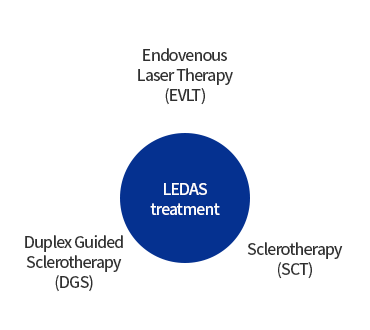
| EVLT (used at LEDAS) | Needle puncture, laser fiber | No incision | Puncture dot, bruising |
| Foam sclerotherapy DGS/UGFS (LEDAS) | Fine needle under ultrasound | No incision | Firm or darkened vein, staining |
| Sclerotherapy SCT (LEDAS) | Fine needle into visible vein | No incision | Bruising, staining, rare matting |
| Ambulatory phlebectomy | Small skin nicks | Small incisions | Small marks, bruising |
| Vein stripping | Groin and leg incisions | Yes | Incision scars, longer bruising |
Scars after vein treatment – frequently asked questions
Will I have a visible mark where the laser fiber went in?
Usually only a tiny dot, like the mark from a blood test, which fades within days to weeks. EVLT is done through a needle puncture, so there is no cut and no stitches. Bruising along the treated vein is common and settles over a couple of weeks.
Why are my veins brown after sclerotherapy?
Brown staining, called hyperpigmentation, comes from iron in trapped blood as the treated vein is absorbed. It is common and usually fades gradually over months. Wearing stockings, walking and avoiding strong sun on the area can help. Ask your doctor at follow-up if it persists.
Is it safe to sunbathe after vein treatment?
Protect treated areas from strong sun while bruising or discoloration is fading, because sun exposure can make pigmentation more noticeable. Use clothing or sunscreen and avoid saunas and very hot baths in the early weeks. Your aftercare instructions list what to avoid.
Do I need stitches after varicose vein treatment at LEDAS?
No. LEDAS treats varicose veins with EVLT and sclerotherapy, which are needle-based and need no incisions or stitches. You are discharged the same day wearing compression stockings and can walk out of the clinic. See local anesthesia, no-incision treatment.
About this page
Clinical information:
LEDAS Varicose Vein Clinic, led by
Dr. Kim Byoung Joon , thoracic and cardiovascular surgeon, founding member of the Korean Society for Phlebology.
Medical reviewer:
Dr. Kim Byoung Joon ·
Review status:
Pending ·
Last updated:
October 2026
This page is general information and not a diagnosis. Treatment is decided only after an in-person examination. Read our
editorial policy .
Related: Laser vs stripping · Side effects & risks · Recovery timeline · Is treatment painful? · Results
Ask about no-incision treatment for your veins
English consultation available · +82-70-4895-5086 · kbjledaspm@gmail.com
