
About LEDAS · Equipment
1940nm Diode Laser for Varicose Vein Treatment
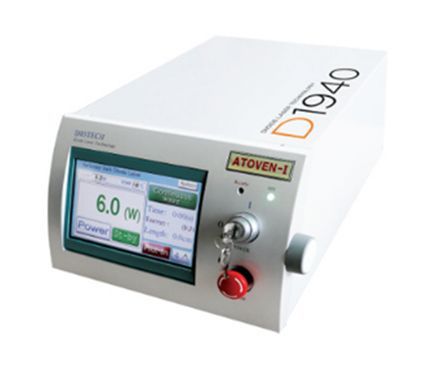
Quick answer: A 1940nm diode laser is used in endovenous laser treatment (EVLT) to close leaking veins from the inside. Light at 1940nm is very strongly absorbed by water in the vein wall, so energy is concentrated where it is needed. LEDAS uses two Diotech 1940nm units, under ultrasound guidance and local anesthesia.
Key facts at a glance
- Device: Diotech 1940nm diode laser, described as fourth-generation; 2 units at LEDAS.
- Used for: endovenous laser treatment (EVLT) of refluxing trunk veins.
- How it works: heat delivered to the inner vein wall seals the vein closed; the body then absorbs it.
- Why 1940nm: strongly absorbed by water, which helps limit heat spread to surrounding tissue.
- Delivery: a thin fiber inserted through a needle puncture, guided by ultrasound.
- Anesthesia: local only; same-day discharge.
What is a 1940nm laser?
A laser produces light of a single wavelength, measured in nanometers (nm). Different wavelengths are absorbed by different things in body tissue. In vein treatment, the goal is to heat the inner wall of a leaking vein enough to seal it shut, while keeping heat away from nearby skin, nerves and tissue.
Light at 1940nm is absorbed very strongly by water, which makes up much of the vein wall. Because it is absorbed so readily, the energy acts over a very short distance. That is why lasers in this range are often described as “water-specific”. LEDAS uses two Diotech 1940nm diode laser units.
How does the laser close a varicose vein?
The laser is used in endovenous laser treatment (EVLT) . “Endovenous” means from inside the vein. The steps are:
- Confirm reflux: the doctor uses duplex ultrasound to confirm backward flow and mark the vein.
- Insert the fiber: a laser fiber about as thin as a hair is passed into the vein through a needle puncture.
- Numb the area: local anesthetic fluid is placed around the vein under ultrasound. It also protects surrounding tissue.
- Treat the wall: the fiber is slowly drawn back while laser energy heats the inner wall, which shrinks and seals.
- Absorption: over the following weeks and months the closed vein is gradually absorbed by the body.
Blood that used to pool in the faulty vein is redirected into healthy veins, which carry it back to the heart properly.
How does 1940nm compare with other wavelengths?
Endovenous lasers have used several wavelengths. Earlier systems, such as 810nm and 980nm, are absorbed mainly by hemoglobin in blood. Later systems, around 1470nm and 1940nm, target water in the vein wall. Water-targeting wavelengths generally allow lower energy settings and are associated with less bruising and discomfort after treatment. Outcomes also depend on the doctor's technique, the fiber used and the accuracy of the ultrasound map. Our 1940nm vs 980nm/1470nm comparison explains this in more detail.
What does it feel like?
You are awake throughout. The local anesthetic injections cause brief stinging. During the laser stage most people feel pressure or warmth rather than pain. After treatment, a pulling or tight feeling along the treated vein is common for 1–2 weeks; gentle walking and ankle exercises help. Bruising is usually mild. See the recovery timeline .
Is the laser used on its own?
No. At LEDAS the laser closes the main leaking trunk veins. Smaller and hidden veins are treated with duplex-guided sclerotherapy and visible spider and reticular veins with sclerotherapy . This combination is the LEDAS treatment system . LEDAS does not offer radiofrequency ablation (RFA) or VenaSeal glue.
Who is not suitable for laser treatment?
Laser treatment may not be suitable if you have an active deep vein thrombosis, are pregnant, cannot walk, or have certain other medical conditions. Some veins are too small or twisted for a fiber and are better treated with injections. The decision is made after your ultrasound. Read is laser vein treatment safe?
Endovenous laser wavelengths compared
| 810–980nm | 1470nm | 1940nm (used at LEDAS) | |
|---|---|---|---|
| Main target | Hemoglobin in blood | Water in vein wall | Water in vein wall (stronger absorption) |
| Typical energy needed | Higher | Lower | Lower |
| Heat spread | Wider | Narrower | Very narrow |
| Post-treatment bruising and discomfort | More commonly reported | Less commonly reported | Less commonly reported |
| Anesthesia | Local (tumescent) | Local (tumescent) | Local (tumescent) |
1940nm laser – frequently asked questions
Does the 1940nm laser leave scars?
The laser is delivered through a fiber inserted via a needle puncture, so there is no surgical incision. The puncture site is very small and usually fades over time. Some people notice temporary bruising or darkening along the treated vein. Read will treatment leave scars?
Is a 1940nm laser better than radiofrequency ablation?
Both are established thermal methods for closing leaking veins, and both have good evidence. The right choice depends on your vein anatomy and the doctor's experience. LEDAS uses EVLT with a 1940nm laser and does not offer RFA. See EVLT vs RFA for a neutral comparison.
How long does laser treatment of one leg take?
The laser part itself is relatively short, and the whole treatment visit, including preparation, ultrasound, local anesthesia and supervised walking, takes most of a day. You go home the same day. See how long EVLT takes for a step-by-step breakdown.
Can both legs be treated with the laser on the same day?
Sometimes. It depends on how many veins need treating, how much local anesthetic is required and your general health. Dr. Kim will advise after your ultrasound. Read more on treating both legs.
About this page
Clinical information:
LEDAS Varicose Vein Clinic, led by
Dr. Kim Byoung Joon , thoracic and cardiovascular surgeon, founding member of the Korean Society for Phlebology.
Medical reviewer:
Dr. Kim Byoung Joon ·
Review status:
Pending ·
Last updated:
October 2026
This page is general information and not a diagnosis. Treatment is decided only after an in-person examination. Read our
editorial policy .
Related: EVLT · 1940nm vs 980nm/1470nm · EPIQ Elite ultrasound · EVLT vs RFA · Is laser treatment safe?
Ask whether 1940nm laser treatment suits your veins
English consultation available · +82-70-4895-5086 · kbjledaspm@gmail.com
