
Conditions · Complications
Varicose Veins and Pulmonary Embolism Risk
Quick answer: A pulmonary embolism (PE) happens when a blood clot, usually from a deep leg vein, travels to the lungs. Varicose veins themselves rarely cause PE directly, but advanced vein disease can raise the risk of deep vein thrombosis, which is the usual source. Sudden breathlessness or chest pain is an emergency: call 119 in Korea.
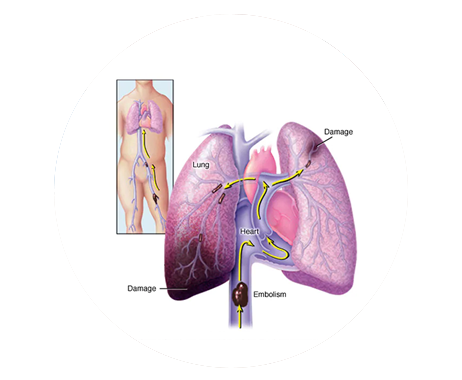
Key facts at a glance
- Pulmonary embolism (PE): a blockage of an artery in the lungs, most often by a clot that travelled from a leg vein.
- Usual source: deep vein thrombosis (DVT) , not the visible surface veins.
- Effect: reduces oxygen supply and strains the heart; it can cause sudden death, sometimes without earlier warning signs.
- Warning signs: sudden shortness of breath, sharp chest pain on breathing, fast heartbeat, coughing blood, fainting.
- Emergency number in Korea: 119. Do not drive yourself.
- Prevention focus: keep blood moving, treat progressive vein disease, and act early on DVT symptoms.
What is a pulmonary embolism?
A pulmonary embolism (PE) is a sudden blockage in one of the pulmonary arteries, the vessels that carry blood from the heart to the lungs. In most cases the blockage is a blood clot that formed somewhere else, most often in a deep vein of the leg or pelvis, then broke loose and travelled with the bloodstream.
When part of the lung loses its blood supply, less oxygen reaches the body and the right side of the heart has to work much harder. A small PE may cause mild breathlessness. A large one can cause collapse or sudden death. This is why PE is treated as a medical emergency everywhere in the world.
Can varicose veins cause a pulmonary embolism?
This is one of the most common worries we hear from patients, so it deserves a clear answer.
- Simple varicose veins rarely cause PE directly. The bulging veins you can see sit close to the skin. Clots in them are usually small and tend to stay put.
- The real link is through DVT. In untreated chronic venous disease, faulty valves let blood pool in the legs. Slow blood is more likely to clot. If a clot forms in, or spreads into, a deep vein, it can travel to the lungs.
- A clot near a junction matters. When a surface vein clot forms close to where the great or small saphenous vein joins the deep veins, it can extend inward. These clots need prompt ultrasound assessment.
In other words, varicose veins are rarely an emergency, but they are a sign that your venous circulation is not working normally. Leaving progressive disease untreated for years removes a safety margin.
What are the warning signs of PE?
Call emergency services immediately (119 in Korea, or your local number) if you notice:
- Sudden shortness of breath, at rest or with light activity
- Sharp chest pain that is worse when you breathe in or cough
- A fast or irregular heartbeat
- Coughing up blood
- Light-headedness, fainting or bluish lips
These symptoms are more alarming if you also have a swollen, painful leg, recently had surgery, or recently took a long flight. Do not wait to see if they pass, and do not book a clinic appointment instead. LEDAS is an outpatient vein clinic; acute PE needs a hospital emergency department.
Who is at higher risk?
- People with a current or past DVT
- People who have been immobile: bed rest, long hospital stays, long-haul travel
- Recent surgery, especially of the hip, knee or abdomen
- Pregnancy and the weeks after childbirth
- Hormone treatment, including some oral contraceptives
- Inherited clotting tendencies, cancer, older age and obesity
- Advanced chronic venous disease with swelling and skin changes
How do vein specialists reduce the risk?
The most practical way to reduce PE risk linked to vein disease is to find and deal with problems before a clot forms . At LEDAS, a duplex ultrasound checks the deep veins as well as the varicose veins. If a clot or signs of an old clot are found, Dr. Kim Byoung Joon will explain what it means and whether you need referral before any vein treatment.
When treatment is suitable, LEDAS closes refluxing veins with EVLT and duplex-guided sclerotherapy . Local anesthesia only means you can walk right after the procedure, which supports healthy blood flow. Walking practice, compression stocking training and monitoring are part of every treatment day before same-day discharge.
Everyday prevention
- Break up long sitting with short walks every hour or so
- Do ankle pumps on flights and in cars; read flying after vein treatment if you are travelling home after care
- Stay hydrated and limit alcohol when travelling
- Wear prescribed compression stockings
Which symptoms need what kind of help?
| Symptom | Possible meaning | What to do |
|---|---|---|
| Sudden breathlessness or chest pain | Possible pulmonary embolism | Call 119 (Korea) or local emergency number now |
| Sudden swelling and pain in one leg | Possible deep vein thrombosis | Same-day emergency or urgent care assessment |
| Hard, red, tender varicose vein | Superficial thrombophlebitis | See a doctor within 1–2 days for ultrasound |
| Heaviness and evening ankle swelling | Chronic venous disease | Book a vein ultrasound consultation |
| Visible bulging veins, no pain | Varicose veins | Routine assessment when convenient |
Pulmonary embolism and vein disease – frequently asked questions
Can a clot in a visible varicose vein reach my lungs?
It is uncommon. Clots in surface varicose veins usually stay local. The risk rises if the clot sits near a junction with the deep veins or spreads into them. That is why a painful, hardened varicose vein should be checked with ultrasound within a day or two.
Does treating varicose veins prevent pulmonary embolism?
Treatment cannot promise that you will never have a clot, because many PE risk factors are unrelated to varicose veins. It does remove pooling blood in diseased surface veins and stops progression of chronic venous disease, which is one contributor. Regular follow-up ultrasound also helps detect problems early.
Is it safe to fly with varicose veins?
Most people with varicose veins fly safely. Long flights do raise clot risk for everyone, so walk the aisle, flex your ankles, drink water and consider compression stockings if your doctor recommends them. See long-haul flights and DVT prevention for practical steps.
What happens if a PE is suspected in Korea?
Call 119 for an ambulance. Hospital emergency departments in Korea can perform CT scans and start treatment, usually with blood-thinning medicine. If you are a LEDAS patient, let our coordinator know afterward so your vein care can be planned safely around it.
About this page
Clinical information:
LEDAS Varicose Vein Clinic, led by
Dr. Kim Byoung Joon , thoracic and cardiovascular surgeon, founding member of the Korean Society for Phlebology.
Medical reviewer:
Dr. Kim Byoung Joon ·
Review status:
Pending ·
Last updated:
October 2026
This page is general information and not a diagnosis. Treatment is decided only after an in-person examination. Read our
editorial policy .
Related: DVT and varicose veins · Superficial thrombophlebitis · Complications of untreated varicose veins · Chronic venous insufficiency · Are varicose veins dangerous?
Worried about clots? Have your leg veins checked properly
For emergencies call 119 · For consultations: +82-70-4895-5086 · kbjledaspm@gmail.com
