
Conditions · Chronic Venous Insufficiency
Chronic Venous Insufficiency: Signs and Treatment
Quick answer: Chronic venous insufficiency (CVI) is long-term failure of the leg veins to return blood to the heart, causing swelling, skin darkening, hardening and eventually ulcers (CEAP stages C3–C6). Treatment closes the leaking veins to lower pressure in the leg. At LEDAS this means ultrasound-guided sclerotherapy and EVLT under local anesthesia, plus compression.
Key facts at a glance
- Definition: chronic venous disease advanced enough to cause swelling or skin damage — CEAP C3 to C6.
- Cause: persistent high pressure in leg veins (venous hypertension), usually from valve reflux, sometimes from vein blockage after a clot.
- Course: swelling → skin inflammation and darkening → hardening → skin breakdown and ulcers.
- Diagnosis: duplex ultrasound of superficial, perforator and deep veins.
- LEDAS approach: where skin is damaged, ultrasound-guided sclerotherapy is recommended first; EVLT for refluxing trunk veins.
- Supportive care: medical compression, leg elevation, walking, skin care.
What is chronic venous insufficiency?
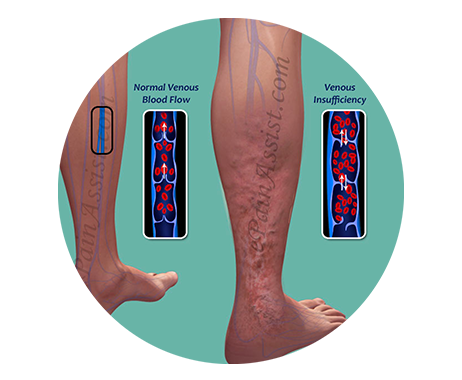
Chronic venous insufficiency (CVI) is what happens when leg veins have failed to work properly for a long time. Normally, one-way valves and the calf-muscle pump move blood upward to the heart. When valves leak ( reflux ) or veins are partly blocked, pressure builds up in the lower leg — a state called venous hypertension . Over months and years, that pressure pushes fluid and blood components into the surrounding tissue, causing swelling, inflammation and damage to the skin.
In the CEAP classification , CVI covers stages C3 (swelling), C4 (skin changes), C5 (healed ulcer) and C6 (active ulcer). Many people with CVI also have visible varicose veins , but some do not.
What are the signs of chronic venous insufficiency?
- Swelling of the ankle and lower leg, worse by evening and better after a night's rest.
- Heaviness, aching and tightness , especially after standing.
- Skin darkening — brown or reddish-brown patches near the ankle.
- Venous eczema — itchy, red, flaky or weeping skin.
- Lipodermatosclerosis — hard, tight, sometimes painful skin that can make the lower leg look like an upside-down bottle.
- Atrophie blanche — smooth white scar-like patches.
- Ulcers — open sores, usually above the inner ankle, that heal slowly. See venous leg ulcers .
What causes chronic venous insufficiency?
Primary reflux
Most often, CVI develops from long-standing varicose veins whose valves have gradually failed. Risk factors include family history, standing or sitting work, pregnancy, ageing and excess weight. See causes of varicose veins .
After a deep vein thrombosis
A previous blood clot in a deep vein can damage its valves or leave it partly blocked. This is called post-thrombotic disease and can lead to CVI even without obvious varicose veins.
Weak calf pump
Reduced ankle movement, for example from arthritis, injury or long periods of immobility, weakens the calf pump and adds to the problem.
How is CVI diagnosed?
A duplex ultrasound is the key test. It shows which veins leak, whether perforator veins near damaged skin are involved, and whether the deep veins are open or scarred from a past clot. At LEDAS, Dr. Kim Byoung Joon scans you standing, using Philips EPIQ Elite ultrasound, and explains the findings on screen. Other causes of leg swelling, such as heart, kidney or lymphatic problems, may need to be considered.
How is chronic venous insufficiency treated?
The goal is to lower pressure in the leg so the skin can recover and ulcers can heal and stay healed.
- Treat the reflux. Closing leaking veins reduces venous hypertension. Where skin is already damaged or ulcerated, surgery becomes harder, so LEDAS recommends non-surgical ultrasound-guided sclerotherapy first, including for refluxing veins beneath damaged skin. EVLT is used for refluxing trunk veins when suitable.
- Compression. Medical compression stockings or bandages reduce swelling and support healing. They help symptoms but do not replace treatment of the cause.
- Skin and wound care. Moisturize dry skin, avoid scratching and keep ulcers clean as advised.
- Daily habits. Walk regularly, do ankle exercises and raise your legs above heart level when resting.
- Follow-up. Regular ultrasound every 1–2 years helps catch new reflux early.
All LEDAS treatments use local anesthesia only, with no incision and same-day discharge.
When is CVI urgent?
Seek prompt care if an ulcer becomes very painful, spreads, smells or is surrounded by spreading redness and fever, which can indicate infection. Call emergency services for sudden severe leg swelling with pain, or sudden breathlessness or chest pain, which can signal a blood clot.
CVI treatment options compared
| Option | What it does | Treats the cause? | Role at LEDAS |
|---|---|---|---|
| Ultrasound-guided sclerotherapy | Foam closes leaking veins, including under damaged skin | Yes | Preferred first step when skin is damaged |
| EVLT (1940nm laser) | Seals refluxing trunk veins from inside | Yes | For suitable saphenous veins |
| Compression stockings | Reduce swelling, support healing | No (supportive) | Used alongside treatment |
| Leg elevation & walking | Improve venous return | No (supportive) | Daily self-care |
| Follow-up ultrasound | Detects new reflux early | Prevents progression | Every 1–2 years |
Chronic venous insufficiency – frequently asked questions
Is chronic venous insufficiency the same as varicose veins?
Not exactly. Varicose veins (CEAP C2) are enlarged surface veins. Chronic venous insufficiency describes more advanced disease with swelling, skin changes or ulcers (C3–C6). Many people with CVI have varicose veins, but CVI can also follow a deep vein thrombosis without visible varicose veins.
Can chronic venous insufficiency be cured?
The underlying tendency cannot be reversed, but treating leaking veins can greatly reduce pressure in the leg, ease swelling and help ulcers heal. Ongoing compression where advised and follow-up ultrasound every 1–2 years help keep the condition under control.
Will the skin darkening go away after treatment?
Pigmentation may fade slowly over months to years once pressure is reduced, but it often does not disappear completely. The main benefit of treatment is stopping further damage. Hardened skin can soften over time. See skin darkening and lipodermatosclerosis.
Can I fly if I have chronic venous insufficiency?
Usually yes, with precautions: wear compression stockings, walk the aisle, flex your ankles and drink water. CVI and long flights both raise clot risk. Read long-haul flights and DVT prevention, and ask your doctor about your personal risk.
About this page
Clinical information:
LEDAS Varicose Vein Clinic, led by
Dr. Kim Byoung Joon , thoracic and cardiovascular surgeon, founding member of the Korean Society for Phlebology.
Medical reviewer:
Dr. Kim Byoung Joon ·
Review status:
Pending ·
Last updated:
October 2026
This page is general information and not a diagnosis. Treatment is decided only after an in-person examination. Read our
editorial policy .
Related: CEAP stages · Venous leg ulcers · Leg swelling · Skin changes · Complications
Swelling or skin changes? Don't wait for an ulcer
English consultation available · +82-70-4895-5086 · kbjledaspm@gmail.com
