
Varicose Vein FAQ · Spider Veins
Are Spider Veins Dangerous, or Just Cosmetic?
Quick answer: Spider veins on their own are usually harmless and are often treated for appearance. But they are also the earliest stage (C1) of chronic venous disease, and sometimes they are a surface sign of a leaking vein deeper in the leg. If you also have aching, swelling or bulging veins, an ultrasound check is the safest way to know.
Key facts at a glance
- Spider veins (telangiectasia): tiny red, purple or blue vessels under 1 mm wide, often in a web or starburst pattern.
- Reticular veins: slightly larger (1–3 mm) blue-green veins that often feed spider veins.
- CEAP stage: spider and reticular veins are stage C1 of chronic venous disease.
- Usually: not dangerous in themselves and do not cause clots.
- Medical sign: when paired with heaviness, swelling, cramps or ankle skin changes, they may point to deeper reflux.
- Treatment at LEDAS: sclerotherapy (SCT), after ultrasound to rule out a hidden source.
What are spider veins?
Spider veins , medically called telangiectasia , are tiny dilated blood vessels just under the skin. They look like fine red, purple or blue lines, sometimes branching like a spider's web. They appear most often on the thighs, behind the knees, around the ankles and on the face.
They are different from varicose veins , which are larger, rope-like veins that bulge above the skin. Between the two sit reticular veins : flat blue-green veins a few millimetres wide that often feed clusters of spider veins.
When are spider veins just cosmetic?
Many people have spider veins with no other symptoms. In this case they are generally a cosmetic concern. They do not usually bleed, cause clots or damage the skin. Common causes include:
- Family history and natural vein wall weakness.
- Hormonal changes, such as pregnancy.
- Long hours standing or sitting.
- Ageing skin and connective tissue.
- Sun exposure, especially on the face.
Treating cosmetic spider veins is a personal choice. There is no medical need to remove them if they do not bother you.
When are spider veins a medical sign?
Spider veins become more meaningful when they appear together with other symptoms. LEDAS's own clinical observation is that subjective symptoms can be an indicator of varicose veins even when large veins are not visible. Consider an ultrasound if you also have:
- Heavy, tired or aching legs, especially in the evening.
- Swelling around the ankles.
- Night cramps or restless legs.
- Itching or darkening of the skin near the ankles.
- A cluster of spider veins around the inner ankle (sometimes called corona phlebectatica), which is linked with more advanced venous disease.
- Spider veins that returned quickly after earlier treatment.
In these situations, the spider veins may be fed by venous reflux : blood flowing backwards through a leaking valve in a larger vein. Treating only the surface veins would not fix the cause. Try our self-check checklist to see how your symptoms add up.
How are spider veins assessed at LEDAS?
- Consultation: the doctor asks about symptoms, family history and past treatment.
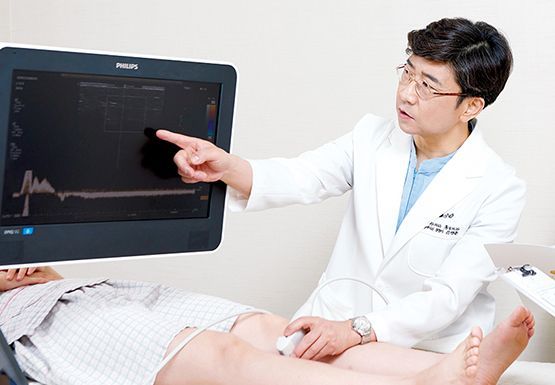
- Standing duplex ultrasound: a 15–20-minute scan checks the saphenous and perforator veins for reflux. You can watch the screen while the doctor explains.
- Plan: if there is no reflux, spider veins can be treated directly with sclerotherapy. If reflux is found, the source vein is treated first, usually with EVLT or foam sclerotherapy .
The first visit with leg ultrasound costs 180,000 KRW. Treatment costs depend on the stage; you receive an exact quote after the ultrasound.
How are spider veins treated?
At LEDAS, spider and reticular veins are treated with sclerotherapy (SCT) . A very fine needle injects medicine into the vein, which closes and fades over several weeks. It takes a few minutes and you return to normal activity the same day. Several sessions may be needed; see how many sclerotherapy sessions .
Can spider veins be prevented?
You cannot change your genes, but you can reduce pressure in your leg veins: walk daily, avoid sitting or standing still for long periods, raise your legs when resting and keep a healthy weight. See how to prevent varicose veins .
Spider, reticular and varicose veins compared
| Spider veins | Reticular veins | Varicose veins | |
|---|---|---|---|
| Size | Under 1 mm | 1–3 mm | 3 mm or more |
| Look | Red/purple fine lines, webs | Flat blue-green lines | Bulging, twisted cords |
| CEAP stage | C1 | C1 | C2 |
| Usually cosmetic? | Often, if no symptoms | Often, if no symptoms | No – a circulation problem |
| Ultrasound advised? | Yes if symptoms present | Yes if symptoms present | Yes |
| Main LEDAS treatment | SCT | SCT | EVLT + DGS/UGFS |
Spider veins – frequently asked questions
Can spider veins turn into varicose veins?
Spider veins do not become varicose veins themselves, but both can come from the same underlying vein weakness or reflux. Someone with spider veins may later develop varicose veins if the cause progresses. An ultrasound shows whether a deeper problem is already present.
Do spider veins mean I have poor circulation?
Not necessarily. Many spider veins are caused by genetics, hormones or ageing skin and have no effect on circulation. If you also have heavy legs, swelling or night cramps, though, venous reflux may be involved and is worth checking with ultrasound.
Does insurance cover spider vein treatment?
Purely cosmetic spider vein treatment is often not covered by insurance. Coverage is more likely when there is documented venous disease. Check with your insurer and ask LEDAS for medical documents. See does insurance cover treatment.
Are spider veins on the face treated the same way?
Facial spider veins are usually caused by sun, skin type or rosacea rather than leg vein reflux, and are commonly treated by dermatologists with surface lasers or light. LEDAS focuses on leg veins and hand veins.
About this page
Clinical information:
LEDAS Varicose Vein Clinic, led by
Dr. Kim Byoung Joon , thoracic and cardiovascular surgeon, founding member of the Korean Society for Phlebology.
Medical reviewer:
Dr. Kim Byoung Joon ·
Review status:
Pending ·
Last updated:
October 2026
This page is general information and not a diagnosis. Treatment is decided only after an in-person examination. Read our
editorial policy .
Related: Spider veins · Reticular veins · CEAP stages · Sclerotherapy · Are varicose veins dangerous?
Find out what is behind your spider veins
English consultation available · +82-70-4895-5086 · kbjledaspm@gmail.com
